
Luftgekühlt Tokyo 2026: A Historic Highway Transformation into a Porsche Masterpiece
By Day: The Elevated Gallery
When the calendar flipped to April 2026, the Japanese car scene witnessed a revolutionary shift from the expected. Forget the standard clamor of the Tokyo Auto Salon or the massive sprawl of Osaka Auto Messe. For enthusiasts worldwide, the true spectacle lay on the now-decommissioned KK Line, a historic stretch of elevated highway bisecting the Kyobashi and Shimbashi districts of Tokyo. This was the stage for Luftgekühlt Tokyo, a singular event that transformed a corridor once defined by traffic into a breathtaking monument to German air-cooled Porsche engineering.
Luftgekühlt, a name synonymous with meticulously curated gatherings celebrating Porsche’s rich heritage, arrived in Japan with a precision that belied the chaos it replaced. An astonishing 220 air-cooled Porsches materialized against the backdrop of the Tokyo skyline, drawing a crowd of 11,600 enthusiasts and marking a paradigm shift in how automotive culture is experienced in the heart of Japan. This was not just a car show; it was an integration of industrial architecture, engineering history, and automotive artistry, set against the backdrop of a city that never truly sleeps.
The Genesis of an Icon
The transformation of the KK Line from a utilitarian artery to a showcase of automotive excellence was a masterstroke in event planning. For years, this elevated expressway served as a vital traffic route, its pylons supporting a continuous stream of vehicles. However, as Tokyo’s urban planning evolved, the line became obsolete, its concrete skeleton standing vacant. Capturing the legacy of the air-cooled Porsche while simultaneously repurposing this structure was a challenge that the Luftgekühlt organizers met with distinction. They effectively borrowed the skeleton of Tokyo’s infrastructure to frame a museum-quality exhibition of Porsche air-cooled cars.
The selection of the air-cooled Porsche as the star attraction was no accident. As a brand, Porsche has historically been defined by its robust air-cooled engines, which powered the iconic 356, 911, and various race cars of the mid-20th century. These vehicles represent a pinnacle of engineering precision and design simplicity, qualities that resonate deeply with German engineering tradition and Japanese aesthetics. In 2026, with the automotive world rapidly transitioning to electric vehicles, celebrating the air-cooled Porsche isn’t merely a nostalgia trip; it is a deliberate effort to preserve a mechanical era that prioritizes raw driving experience over digital intervention. This air-cooled Porsche event served as both a retrospective and a statement about the enduring appeal of analog engineering.
Curating the Fleet
The composition of the 220 Porsche cars on display was a testament to the meticulous curation of the Luftgekühlt team. This was not an event driven by the quantity of cars but by the quality of their stories. The lineup featured a spectrum of German engineering—from early 356 cabriolets that whispered of California sunshine and the origins of the Porsche legend, to menacing 930 Turbos that embodied the raw, untamed spirit of the 1970s and 1980s.
Among the many highlights, the No. 28 Porsche 910, piloted by the legendary Tetsu Ikuzawa, commanded significant attention. Its presence evoked memories of the 1968 Japanese Grand Prix, where it achieved an impressive second place overall and first in its class. This historic Porsche was not merely a static display; it was a living piece of racing history, its chassis marked with the patina of speed and victory. It stood as a tangible representation of the German air-cooled Porsche culture that has captivated enthusiasts for decades.
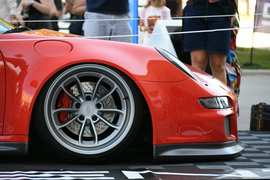
For those with a penchant for street-tuned builds, the Auto Garage TBK demo car emerged as a focal point. Unlike the race cars that dominated the perimeter, this custom build was situated near the center of the exhibit, designed not for track dominance but for aesthetic impact. Its stance and styling were a deliberate juxtaposition against the raw aggression of the race cars, proving that the versatility of the air-cooled Porsche extends beyond the confines of professional motorsport. This Porsche air-cooled was a celebration of grassroots tuning, a community-driven expression of personalization and design.
The Porsche air-cooled cars on display also included rarities rarely seen in public gatherings. Enthusiasts were treated to views of early prototypes that hinted at future design directions, as well as heavily modified examples that blended classic aesthetics with modern performance. The event became a living encyclopedia of Porsche air-cooled history, each car telling a unique story of design evolution, technological innovation, and human passion. For the 11,600 attendees, this was an opportunity to witness automotive engineering that has stood the test of time, a physical manifestation of the Porsche legacy.
The High-CPC Driving Force
In 2026, the economics of high-CPC automotive keywords have shifted. The market for air-cooled Porsche cars for sale, air-cooled Porsche builds, and air-cooled Porsche restorations represents a segment of the classic car market with substantial growth potential and high investment value. The Luftgekühlt Tokyo event amplified this interest, drawing attention to the increasing global demand for vintage Porsche cars and Porsche tuning parts.
For automotive investors, the air-cooled Porsche represents a stable asset class. Unlike modern supercars, whose value depreciates rapidly, air-cooled Porsches often appreciate over time, particularly limited-edition models and rare variants. This has led to a surge in the market for Porsche restoration companies and air-cooled Porsche tuners, businesses that cater to enthusiasts looking to preserve or enhance their classic vehicles. The event itself attracted potential buyers and sellers, creating a dynamic marketplace where classic Porsche models change hands and air-cooled Porsche values are discussed openly.
The German air-cooled Porsche culture is also a significant driver of the air-cooled Porsche market. Enthusiasts who attend air-cooled Porsche events are often seeking to connect with the community, exchange knowledge, and discover new tuning parts and restoration services. The market for air-cooled Porsche builds is driven by a desire for unique, personalized vehicles that reflect the owner’s individual style and taste. For air-cooled Porsche tuners, these events serve as platforms to showcase their skills and attract new clients.
By Night: The Underground Afterparty
While the daytime atmosphere of Luftgekühlt Tokyo was characterized by a clean, gallery-like precision, the true transformation occurred as the sun began to set over Tokyo. As the city lights began to shimmer, the event evolved into a sophisticated, underground afterparty—a scene that could only be staged in the most dynamic city on earth. The atmosphere shifted from one of hushed reverence to one of energetic camaraderie, capturing the essence of the underground automotive scene that thrives in the shadows of the neon metropolis.
Illest and Fatlace founder Mark Arcenal, a figure synonymous with grassroots automotive culture, attended the event and was visibly moved by the experience. “Luft Tokyo was a once-in-a-lifetime experience that I don’t think will ever be duplicated as that area of freeway will turn into retail and a park, I believe,” Arcenal commented. “Glad to experience it and see some of the coolest cars around Tokyo.” His perspective underscored the unique, ephemeral nature of the event. The air-cooled Porsche event was not just a collection of cars; it was a temporal phenomenon, existing only for a fleeting moment in history.
The Culinary and Social Fusion
Japanese automotive events are typically defined by their seamless integration of automotive culture and local gastronomy. In 2026, this tradition continued at Luftgekühlt Tokyo. While the daytime event offered opportunities to explore the city’s bustling districts, the night transformed the atmosphere into one of intimate connection and shared passion. The Luftgekühlt Tokyo experience was defined by more than just the cars; it was about the people and the shared moments that brought them together.
The culinary element of the event was particularly noteworthy. Amidst the towering structures of Tokyo, enthusiasts sought refuge in local restaurants and konbini stores, savoring authentic Japanese cuisine. The konbini food, specifically konbini fried chicken, became an unexpected highlight of the event, offering a contrasting flavor profile to the German engineering on display. This juxtaposition of high-end German automotive craftsmanship with everyday Japanese comfort food symbolized the fusion of cultures that defined the German air-cooled Porsche culture in Japan.
The Future of Luftgekühlt Tokyo
Mark Arcenal’s observation about the future of the KK Line is a sober reminder of the fleeting nature of the Luftgekühlt Tokyo event. The transformation of the highway into retail and a park signifies a broader trend in urban redevelopment where historic landmarks are reimagined for modern use. This makes the air-cooled Porsche event a historic moment, a milestone that may never be replicated in the same way again. The preservation of this unique location for the event will be remembered as a crucial chapter in the history of Porsche air-cooled cars.
The event’s legacy extends beyond the KK Line. It has set a new benchmark for automotive gatherings, demonstrating that the air-cooled Porsche culture is not confined to traditional venues but can thrive in unconventional settings. As air-cooled Porsche events continue to gain popularity worldwide, Luftgekühlt Tokyo will serve as an inspiration for future organizers to push the boundaries of automotive exhibition and create unforgettable experiences for enthusiasts. The air-cooled Porsche event has proven that the appeal of the air-cooled Porsche