🔻 WATCH THE VIDEO BELOW 🔻

The Pinnacle of Automotive Aesthetics: Charting the Fastest Pagani Hypercars
For close to three decades, the Pagani name has stood as a benchmark for automotive artistry and relentless speed in the world of supercars. The vision of Horacio Pagani, an engineer whose Argentinian heritage blends seamlessly with an Italian spirit, has continuously pushed the limits of hypercar design and engineering. From his early influences in Formula 2 racing to his groundbreaking work with composite materials at Lamborghini, he laid the foundation for a brand dedicated not just to performance, but to creating rolling sculptures that redefine desirability and push the boundaries of driving dynamics.
My decade immersed in the elite world of exotic automobiles has given me a unique perspective on the evolution of automotive engineering. Witnessing firsthand the dedication, obsession, and raw ingenuity poured into machines bearing the Pagani name has built a deep respect for this specific niche of the industry. It’s a field where bleeding-edge innovation meets a near-religious commitment to detail, where every sculpted curve, precisely chosen material, and tuned component come together to create an experience that goes far beyond mere transport. This exploration looks at the most potent Pagani creations, dissecting their top speeds and reflecting on the revolutionary technologies and unwavering design philosophies that have cemented their legendary status.
Horacio Pagani’s own journey is a compelling story of relentless ambition. Born in 1955, his early years were defined by a fascination with sports cars, a passion that would eventually shape his entire life. By his early twenties, he had already proven his engineering talent by building his first Formula 2 race car. Early professional work, including time with Renault focusing on racing aerodynamics, gave him a valuable technical grounding. However, it was his move to Italy in 1983 and his subsequent employment at Lamborghini that truly set the stage for his remarkable career.
Lamborghini, a brand Horacio long admired, offered him a chance to work in the high-pressure world of Italian car manufacturing. Starting at the ground floor of a company with fewer than 200 employees, Horacio’s natural talent quickly moved him up the ladder. His sharp eye and forward-thinking approach led him to explore the revolutionary potential of composite materials. Despite facing initial resistance from traditional mindsets, Horacio was a strong believer in the incredible strength-to-weight ratio these new materials offered. His persistent research and development efforts paid off when he successfully incorporated composite parts into the chassis of the Lamborghini Countach anniversary edition, a key moment that foreshadowed the materials his own company would later master.
By 1991, with years of experience and a clear vision, Horacio left Lamborghini to start Pagani Automobili. This crucial step gave him the freedom to pursue his intense ambition of creating the ultimate supercar, without the limitations and compromises often found in larger manufacturers. The Pagani models that have appeared since then are a direct result of this freedom, each a powerful reflection of Horacio’s obsessive attention to detail and his unyielding pursuit of perfection.
Our focus in this detailed look is the measurable peak of Pagani’s engineering skill: their absolute top speeds. While Pagani vehicles are globally praised for their overall performance—including precise handling, powerful braking, and an unmatched connection for the driver—examining their maximum velocities offers a unique and interesting look at the raw power and advanced aerodynamics of these automotive masterpieces. We will journey through the lineage of Pagani’s fastest cars, understanding that top speed in a Pagani is rarely the ultimate goal, but rather a natural result of a perfect combination of engineering elements.
Mapping the Summit: Ranking the Fastest Pagani Hypercars by Top Speed
The pursuit of automotive excellence is a continuous process, and within the exclusive circles of Pagani, this journey is defined by increasingly ambitious feats of engineering and design. Let us delve into the impressive family tree of Pagani’s speed machines, recognizing that top speed in a Pagani is rarely an end in itself, but rather a consequence of a symphony of engineering.
2009 Pagani Zonda Cinque Roadster: 217 MPH (Approximately 349 km/h)
A true emblem of ultra-limited production exclusivity, the Zonda Cinque Roadster was a breathtaking spectacle, with only five meticulously crafted units ever produced. This road-legal masterpiece showcased Pagani’s profound mastery of advanced materials, featuring a chassis constructed from a cutting-edge blend of carbon fiber and titanium. Powering this exquisite machine was a potent, naturally aspirated Mercedes-Benz AMG V-12 engine, capable of unleashing a formidable 678 horsepower and 575 pound-feet of torque. The exhaust system, a signature Pagani design, was painstakingly crafted from Inconel and titanium, a testament to the brand’s unwavering commitment to both performance and exclusivity.
The Cinque Roadster was equipped with a lightning-fast 6-speed sequential transmission and an adjustable suspension system, offering a surprising degree of driver adjustability without compromising its inherent sporting intent. Its top speed of 217 MPH was an impressive achievement for its era. However, it is crucial to understand that for Pagani, outright top speed has always been a byproduct of a greater objective: delivering a perfectly balanced and exhilarating driving experience. Even at speeds exceeding 200 MPH, Pagani hypercars are engineered for dynamic composure and unwavering performance, not solely for the purpose of breaking absolute speed records. This ethos is central to the Pagani Zonda value proposition, emphasizing a driver-centric approach.
2020 Pagani Zonda Revolución: 217 MPH (Approximately 349 km/h)
The Zonda Revolución was conceived as a radical reinterpretation of Pagani’s core philosophy, a profound fusion of \”art applied to speed.\” Pagani has consistently maintained a deep and abiding appreciation for the Italian tradition of crafting aesthetically beautiful sports cars, and the Revolución exemplifies this commitment, representing a harmonious integration of visual allure and functional performance.
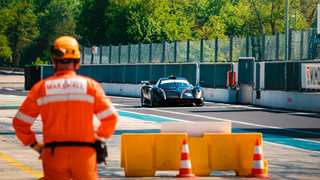
Developed meticulously by Horacio and his highly skilled engineering team, the Revolución was intended for both the rarefied air of private collections and the demanding environment of the racetrack. It was not a road-legal vehicle. Despite its formidable 6.0-liter V-12 engine, now producing a staggering 800 horsepower and tipping the scales at a remarkably light 2,359 pounds, its aerodynamically optimized bodywork was designed to generate substantial downforce. This intense focus on track-oriented aerodynamics, while absolutely crucial for maximizing cornering G-forces and stability at high speeds, inherently limits its top speed potential compared to a vehicle optimized purely for straight-line velocity. Nevertheless, the Pagani Zonda Revolución is also credited with reaching the 217 MPH mark. The Pagani Zonda Revolución price reflects its bespoke nature and extreme performance capabilities.
2002 Pagani Zonda S: 220 MPH (Approximately 354 km/h)
Emanating from the lineage of the original Zonda C12, which made its debut at the Geneva Motor Show in 1999, the Pagani Zonda S was designed to make a profound statement, and it unequivocally succeeded. This iteration featured a potent 7.3-liter V-12 engine sourced directly from Mercedes-AMG, delivering a formidable 555 horsepower and 553 pound-feet of torque at a relatively low 4,050 rpm. Notably, even at a mere 2,000 rpm, this powerplant was already generating an impressive 457 pound-feet of torque. These figures, staggering in 2002, remain remarkably potent even by today’s demanding standards.
During the Zonda S’s era, the automotive landscape was dominated by titans such as the Bugatti Veyron, with its monstrous 1,000-horsepower Quad Turbo W-16. However, the Veyron was primarily conceived as a definitive top-speed champion. A more pertinent comparison for the Pagani Zonda S might be the Ferrari Enzo, launched in the same year. The Enzo, often hailed as one of the first true hypercars, was a lightweight, rear-wheel-drive machine powered by a screaming V-12 that produced 651 horsepower. While the Enzo’s peak horsepower was higher, it was achieved at significantly higher revs, and its torque output of 485 pound-feet was notably lower than that of the Zonda S. Rumors circulated at the time that the Pagani Zonda S was capable of reaching the 220 MPH mark, firmly placing it among the fastest luxury hypercars of its time. Exploring Pagani Zonda S specifications reveals the engineering marvels embedded within.
2017 Pagani Zonda Barchetta: 221 MPH (Approximately 356 km/h)
Horacio Pagani S.P.A. possesses a distinguished history of producing ultra-limited production vehicles, and the Zonda Barchetta stands as a prime example of this philosophy. With a production run of a mere three units, ownership of one of these cars places an individual into an extraordinarily exclusive global club. Tragically, one of these near-priceless automobiles was involved in an accident, underscoring the inherent risks and profound emotional connections tied to such exceptional machines.
The Barchetta is widely regarded as a bespoke creation, meticulously crafted by Pagani and his team primarily for Horacio Pagani himself. It represents a contemporary reimagining of the original 1999 Zonda’s revolutionary design, featuring a dramatically reduced windscreen, open-top configuration, and bespoke carbon fiber bodywork that screams exclusivity. Powering this masterpiece is the potent 7.3-liter Mercedes-Benz AMG V-12 engine, tuned to produce a formidable 760 horsepower. This extreme power-to-weight ratio,