
Decoding Whiplash Defense: Which Small SUVs Excel in IIHS’s Enhanced Rear-Impact Safety Trials?
For a decade in the automotive safety landscape, I’ve witnessed firsthand the relentless pursuit of occupant protection. The Insurance Institute for Highway Safety (IIHS) stands as a formidable force in this arena, its “Top Safety Pick” and “Top Safety Pick+” designations serving as crucial benchmarks for consumers and powerful motivators for manufacturers. Recently, the IIHS has rekindled its focus on a critical yet previously overshadowed area of safety: whiplash protection in rear-end collisions. This re-evaluation comes after a period where the test’s effectiveness seemed to plateau, with nearly all vehicles achieving top marks. However, the persistent reality of whiplash injuries in everyday driving underscored the need for a more nuanced approach.
The IIHS’s decision to revisit whiplash testing is a testament to its commitment to data-driven safety improvements. Back in 2022, the institute paused its dedicated whiplash seat evaluation because the results became almost uniformly excellent. This achievement, while positive, inadvertently masked subtle yet significant differences in how vehicle seats truly protected occupants from the jarring forces of a rear-end impact. Insurance claim data, a less direct but potent indicator, hinted that some designs offered superior protection even when standardized tests didn’t fully differentiate them. As the IIHS aptly noted, “Variations in insurance claim rates for different models showed that some designs provided better protection than others — even if the original test could not identify them.” This subtle discrepancy demanded a refined methodology, one that could capture the finer points of occupant kinematics and head restraint effectiveness.
The Debut of a Refined Rear-Impact Safety Assessment
In its inaugural run with the updated evaluation, the IIHS subjected a diverse array of 18 small SUVs to rigorous testing. With the singular exception of a 2024 Honda CR-V, all vehicles represented the 2025 model year. Given that many of these models saw minimal changes leading into the new year, the findings are largely applicable to their 2026 counterparts as well. The IIHS employs a tiered rating system, with “Good” signifying the highest level of protection, followed by “Acceptable,” “Marginal,” and “Poor” at the bottom.
According to the IIHS, vehicles earning a “Good” rating demonstrated “excellent protection across nearly all the metrics at both impact speeds.” Those deemed “Acceptable” exhibited minor shortcomings in several areas, while “Marginal” vehicles displayed more pronounced deficiencies. The three SUVs that received “Poor” ratings failed across all three assessment criteria and performed exceptionally poorly in at least one. Their most significant failing was an inability to adequately restrict head movement relative to the spine, a critical factor in preventing whiplash.
The results of this significant small SUV safety evaluation reveal a clear hierarchy of protection in rear-end impacts:
Good:
2025 Audi Q3
2025-26 Hyundai Ioniq 5
2025-26 Subaru Forester
2025 Toyota RAV4
Acceptable:
2025-26 Buick Encore GX
2025-26 Chevrolet Equinox
2024-25 Honda CR-V
2025-26 Jeep Compass
2025-26 Kia Sportage
2025 Mercedes-Benz GLB
2025-26 Mitsubishi Outlander
2025-26 Volkswagen Taos
2025-26 Volvo XC40
Marginal:
2025 BMW X1
2025-26 Nissan Rogue
Poor:
2025-26 Ford Bronco Sport
2025-26 Hyundai Tucson
2025-26 Mazda CX-50
Beyond the Basics: The Evolution of Whiplash Metrics
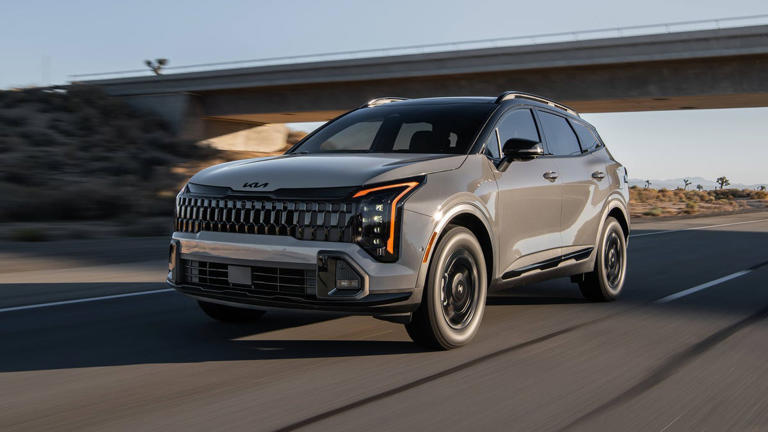
The IIHS’s commitment to advancing automotive safety is evident in its evolving testing methodologies. Historically, the whiplash evaluation involved a sophisticated setup: a vehicle’s seat was mounted onto a sled, which was then rapidly accelerated to simulate a rear-end collision. This acceleration mimicked being struck by a vehicle of equivalent weight at 20 mph. A specially designed dummy, equipped with an articulated spine, was secured in the seat, and measurements were meticulously collected.
The enhanced test retains this core framework but introduces crucial new measurements and metrics, meticulously refined through extensive testing of seats from 36 different vehicles across three distinct impact speeds. This deep dive into real-world crash dynamics allowed IIHS scientists to identify strong correlations between specific kinematic measurements and actual injury rates, drawing on data from the related Highway Loss Data Institute. Key insights emerged from simulations at both 20 mph and 30 mph impacts, leading to the updated evaluation’s comprehensive approach.
Unpacking the Advanced Whiplash Protection Technology
The original whiplash test primarily focused on two key indicators: the time it took for the dummy’s head to make contact with the head restraint, and the acceleration experienced by the T1 vertebra—the final vertebra in the upper spine, where it transitions into the neck. The new test builds upon this foundation by incorporating the crucial measurement of pelvic displacement relative to the head. In a rear-end collision, a properly functioning seat should encourage the occupant to sink into the seatback, maintaining a stable and consistent relative position between the pelvis and the head. This is paramount for absorbing impact forces effectively.
Furthermore, the updated evaluation meticulously assesses the forces that cause the head to tilt or bend relative to the neck. For optimal protection, the head restraint must engage the occupant’s head near its center of gravity. If the restraint contacts the head above this point, it can force the chin downward, towards the chest. Conversely, contact below the center of gravity can result in the head tilting backward and upward. These nuanced measurements provide the IIHS with an unprecedentedly comprehensive understanding of how well a vehicle’s seat and head restraint system manage crash energy and support the occupant’s head and spine. A “Good” rating in this advanced test necessitates that the seat not only keeps the head and spine aligned but also allows the neck to maintain its natural curvature. Crucially, it underscores the importance of properly positioned, and often adjustable, head restraints—a simple yet vital component in automotive safety technology and preventing neck injury prevention during accidents.
Navigating the Small SUV Market: What the Results Mean for Buyers
For consumers in the market for a new small SUV, these IIHS ratings offer invaluable insight beyond mere marketing claims. They represent a quantifiable assessment of how well a vehicle is engineered to protect occupants in a common and often debilitating type of collision. The distinction between a “Good” and a “Poor” rating in whiplash protection can translate to significantly different outcomes in terms of injury severity and recovery time.
The Subaru Forester, a perennial favorite for its practical design and all-wheel-drive capability, once again demonstrates its commitment to occupant safety, securing a top “Good” rating. Similarly, the 2025 Toyota RAV4 continues its legacy of strong safety performance, earning the highest marks. The Hyundai Ioniq 5, an innovative electric vehicle, also stands out, proving that cutting-edge technology can be married with robust safety engineering. The Audi Q3 rounds out the “Good” performers, showcasing German engineering prowess in this critical area.
For those considering vehicles that received “Acceptable” ratings, such as the Chevrolet Equinox or the popular Honda CR-V, these models still offer a commendable level of protection. However, the “Acceptable” classification indicates that there are minor areas where the seat design could be further optimized to mitigate whiplash forces. Buyers opting for these models should be aware of these nuances, especially if their driving habits involve frequent exposure to high-traffic environments where rear-end collisions are a greater concern.
The “Marginal” ratings, as seen with the BMW X1 and Nissan Rogue, suggest areas for improvement in head restraint geometry and seatback design. While not outright failures, these vehicles do not offer the same level of confidence in whiplash mitigation as their higher-rated counterparts.
The “Poor” ratings for the Ford Bronco Sport, Hyundai Tucson, and Mazda CX-50 are particularly noteworthy. These SUVs demonstrated significant shortcomings in protecting occupants from whiplash-inducing forces. This raises important considerations for potential buyers of these models, prompting a deeper investigation into their vehicle safety features and a careful weighing of the risks against their other attributes. It is imperative for consumers researching SUV safety ratings to pay close attention to these distinctions, especially when considering new car purchases for families or individuals who prioritize robust protection.
The Broader Impact: Driving Innovation in Automotive Safety
The IIHS’s renewed focus on whiplash protection is more than just an updated test; it’s a strategic imperative to drive innovation across the automotive industry. By shining a spotlight on the subtle engineering nuances that differentiate effective whiplash protection from less effective designs, the IIHS is compelling manufacturers to invest further in this often-overlooked aspect of crashworthiness. This could lead to widespread adoption of improved seat designs, more advanced head restraint technology, and a greater emphasis on the biomechanics of rear-impact collisions in the early stages of vehicle development.
This rigorous evaluation also empowers consumers with more granular information, allowing them to make more informed decisions. When considering used car safety reviews or comparing new SUV models, understanding these specific safety metrics can be a deciding factor. For instance, a buyer in a city like Los Angeles or Houston, where traffic congestion is a constant factor, might place a higher premium on vehicles that excel in whiplash protection. Similarly, parents looking for the safest vehicle for their teenage drivers navigating the streets of Chicago or Phoenix will find this data indispensable. The availability of detailed IIHS crash test results for modern vehicles is crucial for fostering a culture of safety awareness and demanding continuous improvement.
The IIHS’s approach, integrating real-world insurance data with advanced crash simulation, represents a sophisticated and forward-thinking strategy. It moves beyond simply passing a standardized test to understanding the complexities of how vehicle structures and occupant restraints interact during a crash. This deep dive into automotive accident prevention and injury mitigation is essential for creating a future where vehicle occupants are better protected from the diverse array of risks they face on the road.
Ultimately, the IIHS’s refined whiplash protection test serves as a vital tool for advancing automotive safety. It challenges manufacturers to push the boundaries of engineering and design, and it equips consumers with the knowledge they need to make choices that prioritize their well-being. As the automotive landscape continues to evolve, driven by electrification and autonomous technologies, maintaining and enhancing occupant protection in all types of collisions remains a fundamental and non-negotiable priority.
When you’re exploring your next vehicle purchase, whether you’re in the market for a dependable Subaru Forester for sale in Denver, a versatile Toyota RAV4 SUV in Atlanta, or any other safe SUV model, make sure to consult the latest IIHS ratings. Understanding these detailed evaluations can significantly enhance your confidence in the safety and protection your chosen vehicle offers.