
Your Definitive Guide to Buying a Chevrolet Colorado: Navigating Value, Reliability, and the Best Model Years
For over two decades, the Chevrolet Colorado has carved out a significant niche in the midsize pickup truck segment. Replacing the venerable S-10 in 2003, the Colorado offered a larger, more substantial platform, designed collaboratively with GM’s international divisions and Isuzu. This global design heritage meant the Colorado shared its DNA with vehicles sold under various brands worldwide, including Holden in Australia and New Zealand, and even had a brief fraternal twin in the U.S. as the GMC Canyon and Isuzu i-Series. As an industry expert with a decade of hands-on experience with these trucks, I’ve seen firsthand how the Colorado has evolved, offering compelling options for buyers seeking capability and value without the footprint of a full-size pickup.
The initial generation of the Chevrolet Colorado presented a bold, stylish departure from its predecessor. While its interior might have been considered somewhat utilitarian and its base engine lacked assertive power, its exterior design was undeniably attractive, and its utility was substantial. From its inception, Chevrolet offered specialized variants like lowered sport trucks and the rugged Z71 off-road package. In its early form, the Colorado boasted a respectable payload capacity of up to 1,733 pounds and could tow 4,000 pounds. While these figures might seem modest by today’s standards, they laid the groundwork for the Colorado’s growth in size and capability.
Chevrolet bestowed a significant refresh upon the first-generation Colorado for the 2008 model year, extending its run through 2012. Although sales had begun to taper off by that point, Chevrolet’s commitment to the midsize segment remained. A completely re-engineered second-generation model debuted for the 2015 model year. This iteration also benefited from international development, having initially been unveiled in Thailand in 2011. However, GM meticulously tailored it for the American market, and importantly, it was manufactured domestically. The second-generation Colorado marked a substantial leap forward in powertrain options, introducing a potent V6 and an exceptionally fuel-efficient, torque-rich turbodiesel. This diesel engine, in particular, offered an impressive towing capacity of up to 7,700 pounds, a figure that rivaled some full-size trucks of the era.
The Chevrolet Colorado underwent its most recent and comprehensive redesign for the 2023 model year, ushering in its third generation. This latest iteration saw the discontinuation of the V6 and diesel powertrains, replaced by a sophisticated lineup of turbocharged four-cylinder gasoline engines. Furthermore, the 2023 Colorado received a significant upgrade in active safety features and a markedly more refined interior—two areas where the preceding generation had faced criticism. The current Colorado stands as a formidable contender in its segment, directly challenging freshly redesigned rivals such as the Toyota Tacoma, Nissan Frontier, and Ford Ranger. It also competes, albeit with slightly different market positioning, against other midsize trucks like the Honda Ridgeline and Jeep Gladiator, with the specialized Colorado ZR2 Bison proving particularly adept in off-road scenarios against these competitors.
While the Colorado has certainly grown over the years, it retains a more manageable size compared to Chevrolet’s full-size Silverado, making it a more practical choice for those with limited garage space or a preference for nimbler handling. This guide is meticulously crafted to provide a comprehensive overview of each Chevrolet Colorado generation, empowering you to make an informed decision. We will delve into the core attributes of each model, offering practical advice on what to seek, what to avoid, and crucially, what constitutes a fair market price for a used Chevrolet Colorado.
Understanding Chevrolet Colorado Generations: A Deep Dive for Savvy Buyers
Navigating the landscape of used trucks can be daunting, especially when considering models that have undergone significant redesigns. The Chevrolet Colorado, with its distinct generations, presents a fascinating case study. As a seasoned professional in this field, I’ve observed the nuances of each iteration and can guide you through the optimal years and configurations to target.
Third Generation: 2023 to Present – The Modern Evolution
Chevrolet embarked on a complete overhaul for the third-generation Colorado, introducing a slew of significant changes. A brand-new, larger body sits atop a revised frame, complemented by new powertrains, a strikingly modern and technologically advanced interior, and desirable new configurations. However, this evolution comes with trade-offs.
The current Colorado is exclusively offered as a crew cab with a short five-foot bed. The extended cab variant, which persisted until 2012, is no longer available, mirroring the discontinuation of the regular cab after that model year. This means your bed length options are now limited. Gone too are the V6 and the economical turbodiesel. While the diesel was a slower seller, it offered class-leading towing and excellent fuel economy.
In their place, Chevrolet has implemented a 2.7-liter turbocharged four-cylinder engine, branded as “L3B,” available in three distinct power outputs. Base models deliver 237 horsepower and 259 lb-ft of torque. The Z71 and Trail Boss trims elevate this to 310 horsepower and 390 lb-ft of torque. The top-tier ZR2 matches the horsepower but boosts torque to an impressive 430 lb-ft. This engine, shared with the Silverado, provides more than ample performance for the midsize Colorado, which now approaches full-size dimensions. All configurations employ a responsive and reliable eight-speed automatic transmission. Rear-wheel drive is standard, with four-wheel drive being an optional upgrade. Notably, for 2024, Chevrolet made the higher-output engine standard on the Z71 and Trail Boss models, rebranding it as the TurboMax.
The cabin has been thoroughly redesigned. While it doesn’t offer significantly more rear-seat space, the aesthetic and tactile experience is vastly improved, despite the continued use of some hard plastics. A prominent 11.3-inch touchscreen is standard, paired with an 8-inch digital instrument display. An optional 11.3-inch digital gauge cluster is also available. The graphics are sharp, and Chevrolet’s infotainment system is intuitive and user-friendly, featuring integrated Google services. Off-road focused models incorporate specialized displays that are genuinely useful. Active safety features are now far more prevalent, with many being standard or optional, including adaptive cruise control.
The third-generation Colorado is available in five trims: WT (Work Truck) and LT, which carry over their established roles as workhorse and entry-level consumer trucks, respectively. Above these sit the new Trail Boss, a value-oriented off-roader that competes effectively with rivals like the Tacoma TRD Off-Road and Frontier Pro-4X. The Z71 offers a well-equipped package with a modest emphasis on off-road capability.
Capping the lineup are the ZR2 and the reintroduced ZR2 Bison. Both are formidable off-road machines, capable of matching or surpassing the performance of the Ford Ranger Raptor and Tacoma TRD Pro. The ZR2 Bison, which returned for 2024, adds significant aftermarket-inspired off-road hardware and a distinctive appearance, though the standard ZR2 often presents a better value proposition due to the considerable cost of the Bison package.
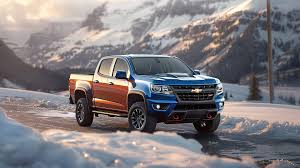
For the 2025 model year, the Colorado remains largely unchanged, with Chevrolet introducing blacked-out Midnight Editions for select trims and adding blind-zone steering assist with an extended view for trailer towing. The TurboMax engine is now the sole powertrain option.
When considering a brand-new third-generation Colorado, expect pricing to start around $32,400 before a $2,095 destination charge. On the used market, the earliest models from this generation are already appearing, with average prices hovering around $34,000. These used examples may offer a more feature-rich package than a base-model new truck.
Second Generation: 2014 to 2022 – The Midsize Resurgence
Chevrolet’s hesitation in replacing the first-generation Colorado led to a gap in the U.S. market, but a redesigned second-generation model, initially introduced globally in 2011, finally arrived for the 2015 model year, with production commencing in late 2014. No models were produced for the 2013 or 2014 model years. The timing of the Colorado’s U.S. debut was opportune, as the midsize truck market was relatively uncrowded. The Toyota Tacoma and Nissan Frontier were aging designs, and the Ford Ranger had been discontinued in 2011 (though it would later be revived).
Globally, the second-generation Colorado was offered in a regular cab configuration. However, for the U.S. market, it was consistently available in two cab styles: the extended cab with its distinctive rear-hinged doors and the crew cab, featuring full-size rear doors and enhanced rear passenger legroom.
In-cabin technology was somewhat basic initially. Early models featured a rudimentary 4.2-inch screen on base trims, upgrading to an 8-inch Chevrolet infotainment system on higher trims. While user-friendly, it was not cutting-edge. Apple CarPlay and Android Auto integration became standard on the larger screen early on. Later in the generation, lower trim levels received a 7-inch screen and a built-in Wi-Fi hotspot (requiring a data plan).
Two cargo box options were offered. Extended cab models came exclusively with a long box (74 inches). Crew cab models offered a choice between the long box and a short box (61.7 inches). The wheel wells intrude into the bed, measuring approximately 44 inches between them, meaning a standard 4×8 sheet of plywood won’t lie flat. However, Chevrolet incorporated clever recesses in the bed sides designed to accommodate a pair of 2×6 boards, allowing a 4×8 sheet to sit above the wheel wells, further supported by a two-tier tailgate.
As with its predecessor, the Colorado was rear-wheel drive by default, with four-wheel drive as an option. Rear-drive models could be equipped with either a 2.5-liter four-cylinder gasoline engine (205 hp, 195 lb-ft of torque) or a 3.6-liter V6 (305 hp, 269 lb-ft) on WT and LT trims. The Z71 and ZR2 models were exclusively four-wheel drive and came standard with the 3.6-liter V6 engine.
A significant addition for 2016 was the optional 2.8-liter Duramax turbodiesel engine for higher trims. This powerplant produced 181 horsepower and a substantial 369 lb-ft of torque. Its considerable torque output enabled a class-leading 7,700-pound towing capacity (the V6 could tow up to 7,000 pounds) and an impressive highway fuel economy of up to 31 mpg, a remarkable figure for a midsize pickup and significantly more frugal than its gasoline counterparts. All Colorado models featured an automatic transmission: a six-speed for the four-cylinder, an eight-speed for the V6, and a unique six-speed for the diesel.
Prior to 2020, a “base” trim existed, but the WT (Work Truck) trim then became the entry point. It was equipped with a four-way power driver’s seat, a 7-inch color touchscreen, multiple airbags, electronic stability and traction control, manual mirrors, a locking tailgate, the CornerStep rear bumper, and black exterior accents. The LT trim added body-color bumpers, mirrors, and door handles, 17-inch alloy wheels, an 8-inch touchscreen, remote keyless entry, and the EZ-Lift & Lower tailgate.
The sport-oriented Chevrolet Colorado Z71 included an off-road suspension package, an automatic locking rear differential, skid plates, unique wheels with all-terrain tires, automatic climate control, a power lumbar adjustment for the driver, and wireless charging.
At the pinnacle of the lineup, the Chevrolet Colorado ZR2 was equipped with an aggressive off-road appearance package, specialized off-road suspension featuring Multimatic DSSV dampers, increased ground clearance and track width, a spray-on bedliner, unique front styling, a black rear bumper, fender flares, larger 265/65R17 all-terrain tires, leather front seats, and a four-way power passenger seat. In 2019, Chevrolet introduced the ZR2 Bison package, which incorporated even more robust off-road gear from American Expedition Vehicles (AEV). This package has since returned for the third-generation Colorado.
Acquiring advanced safety features often necessitated stepping up from the base trim, with the exception of the federally mandated rearview camera. A high-definition camera was standard on the Z71. Lane departure warning and forward collision warning were optional on LT and Z71 models. Rear park assist was standard on the Z71 and available as part of a package on the LT. Even with all available options, the second-generation Colorado did not offer the same breadth and sophistication of active safety systems as some competitors of that era, particularly the Toyota Tacoma.
The promise of better fuel economy is often associated with smaller trucks. While the Colorado generally offered better mileage than the Silverado 1500, figures could vary. In ZR2 trim, with four-wheel drive and the V6 engine, the EPA estimated a combined MPG of 17 mpg. This figure improved to 23 mpg with the 2.8-liter diesel engine.
Unfortunately, the second-generation Colorado is not without its reliability concerns, primarily stemming from early transmission issues. Models manufactured from 2014 to 2019, and occasionally later, experienced recurring problems with their eight-speed automatic transmissions, manifesting as shaking, jerking, clunking, failure to engage, and complete transmission failure. A class-action lawsuit was filed concerning these issues. Early models also suffered from HVAC system problems, and some owners reported issues with the V6 engine. While later models generally saw improvements, owners continued to report rough shifting.
Despite these drawbacks, the Colorado can be a dependable companion, offering good value. However, it’s advisable to steer clear of the base four-cylinder engines and WT trims if you’re seeking robust performance. For a work truck, the 2019 and newer Ford Ranger base models often present a more compelling package. The Colorado truly shines in its mid-range and higher trims, delivering a well-balanced blend of performance and capability. Earlier models in good condition can be found for approximately $15,000 to $20,000, with top-tier ZR2 models commanding higher prices. Post-2018 trucks typically start around $20,000, with the ZR2 and ZR2 Bison reaching into the low $40,000 range for 2022 models.
First Generation: 2004 to 2012 – The Foundation
The first-generation Chevrolet Colorado emerged in 2004, succeeding the Chevrolet S10, which had debuted in 1982. This truck was a collaborative effort between GM’s Brazilian division and Isuzu, and its global reach meant it was sold under various GM badges, including Holden. In the U.S., it was also offered as the GMC Canyon and the Isuzu i-Series.
The original Colorado was available in three cab configurations: regular, extended, and crew. Regular and extended cab models featured a six-foot bed, while the crew cab’s bed was a foot shorter. A notable, though rarely ordered, feature was a side-opening door on some beds, a design element not seen on GM pickups since the 1960s. All first-generation Colorados were offered in either rear-wheel drive or four-wheel drive.
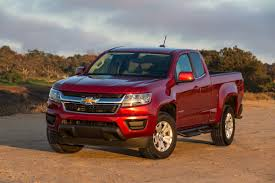
Three distinct suspension setups were available: the ZQ8, a low-slung street truck variant (rear-drive only); the standard Z85 suspension; and the lifted Z71 off-road suspension. Visually, these suspensions contributed to different aesthetics. The ZQ8 offered a performance truck look with color-coded bumpers and stylish wheels, while the Z71 featured fender flares and larger tires, signifying its off-road prowess.
Early Colorado pickups were powered by either a 2.8-liter inline four-cylinder or a 3.5-liter inline five-cylinder engine. This made the Colorado and its GMC and Isuzu siblings the only U.S. pickups to offer a five-cylinder engine at that time. For 2007, alongside a facelift, Chevrolet introduced two new engines to replace the 3.5-liter: a 2.9-liter four-cylinder and a 3.7-liter five-cylinder. These engines were developed in response to consumer feedback regarding issues with earlier powertrains, including valve seal problems, cylinder head failures, and overheating.
The initial trim levels were Base and LS. Base models were quite spartan, featuring an AM/FM two-speaker stereo, manual locks, and a fixed steering column, though air conditioning and power steering were standard. The LS offered an upgraded audio system, power windows and locks, a tilt steering wheel, and additional interior comfort and convenience features. Later in the generation, Chevrolet introduced an LT trim, positioned between the Base and LS, and a higher LTZ trim.
The 2009 model year brought Bluetooth hands-free phone connectivity, and the single-disc CD player was replaced by a six-disc changer on most trims above Base. Various sizes of aluminum wheels became standard on all but the Base trim, which retained steel wheels. SiriusXM satellite radio and OnStar were also offered on most trim levels, requiring subscriptions.
Chevrolet Colorado reliability can be a concern for pre-2007 models. Common and frustrating issues include valve seats that are not hardened enough, leading to poor valve sealing, a persistent check engine light, and misfires. The only definitive fix is a cylinder head rebuild, which can be costly. On the five-cylinder engines, cylinder heads are prone to warping or cracking and can be damaged by overheating. The HVAC blower motor is another frequent failure point, along with consistent issues with the emissions system and wiper motors. While most of these problems, aside from the cylinder head issue, are relatively easy to address, later trucks tend to be less susceptible to head problems. Regardless of the year, all first-generation Colorados are vulnerable to rust.
First-generation Colorados are generally easy to find and are not prohibitively expensive. You can locate well-maintained examples with under 100,000 miles for roughly $9,000 to $15,000. While this represents a significant investment for an older truck, it’s often considerably less than a comparable Toyota Tacoma. Furthermore, this generation is physically smaller than its successors, offering the broadest range of cab configurations, making it the ideal choice if you desire a genuinely compact pickup truck.
Key Considerations for Your Chevrolet Colorado Purchase
When venturing into the used truck market for a Chevrolet Colorado, certain factors consistently emerge as critical for making a smart investment. My experience has shown that focusing on specific model years and engine/trim combinations can significantly mitigate potential headaches and maximize your satisfaction.
What to Look For: The Sweet Spots in Colorado History
First Generation (2007-2012): While early models (pre-2007) had notable reliability issues, once Chevrolet addressed the cylinder head and valve seal problems, these later first-gen Colorados became much more robust. The updated 2.9L four-cylinder and 3.7L five-cylinder engines, along with improved reliability, make the 2007-2012 range a solid choice for a more compact and affordable midsize truck. Look for LS and LT trims for a better balance of features and value.
Second Generation (2017-2022): This generation saw significant improvements, especially in its later years. The notorious transmission issues were largely ironed out, making 2017 Chevrolet Colorado and newer models much more reliable. The real stars of this generation are the Duramax diesel engine (offering fantastic torque and fuel economy) and the 3.6L V6. These powertrains provide ample power for towing and daily driving. Opt for Z71 or ZR2 trims if off-road capability is a priority, but be aware that even LT trims with the V6 or diesel offer an excellent blend of comfort and utility. The 2020 Chevrolet Colorado and later models also benefit from a refined interior and more available safety features.
Third Generation (2023-Present): While still relatively new, the third-generation Colorado represents a significant leap forward in technology, safety, and interior refinement. The turbocharged 2.7L engine, particularly in its higher outputs (310 hp and above), provides strong performance. The redesigned interior and standard advanced safety features are major selling points. If budget allows, the new Chevrolet Colorado offers the most modern and feature-rich experience. However, for value on the used market, you might find slightly used examples from 2023 or 2024 that offer significant savings over new.
What to Avoid: Red Flags and Potential Pitfalls
First Generation (2004-2006): As mentioned, these early models are prone to significant engine and cylinder head issues. While they might be cheap upfront, the potential repair costs can quickly outweigh any initial savings. Unless you’re a skilled DIY mechanic looking for a project, it’s generally best to avoid these years.
Second Generation (2014-2016): The early production years of the second-generation Colorado are notorious for widespread issues with the eight-speed automatic transmission. Symptoms can range from rough shifting to complete failure. While some might have been repaired, the risk of recurring problems is high. Be particularly wary of these model years if the transmission history isn’t impeccably documented.
Base Model Engines (Second Generation): While the 2.5L four-cylinder engine in the second-gen Colorado is fuel-efficient, it’s often underpowered for a truck of this size, especially when loaded or towing. Combined with the transmission issues of early models, these can be a less desirable combination.
High-CPC Keywords and Smart Shopping Strategies:
When searching for your next truck, consider incorporating terms like “Chevrolet Colorado for sale near me,” “used Colorado ZR2 price,” “reliable midsize pickup truck deals,” and “best used Chevrolet Colorado years for towing” into your online searches. These phrases not only target specific needs but also often lead to listings from dealerships or private sellers that understand the market value of these highly sought-after configurations. For instance, a “Chevrolet Colorado diesel for sale” will likely yield vehicles equipped with the highly regarded 2.8L Duramax engine, known for its exceptional torque and fuel efficiency, a significant draw for buyers needing Chevrolet Colorado towing capacity.
The term “Chevrolet Colorado lease deals” might also be relevant for those considering newer models and wanting to explore different ownership options. However, for the pre-owned market, focusing on keywords like “used Chevrolet Colorado LT vs Z71” can help you compare value and features between different trim levels, ensuring you get the most bang for your buck.
Reliability Snapshot: What the Data Shows
Best Years: 2007-2012 (first-gen, post-issue resolution), 2017-2022 (second-gen, particularly 2017 and later).
Worst Years: 2004-2006 (first-gen engine/head issues), 2014-2016 (second-gen transmission issues).
Overall Reliability: While the Colorado has had its share of challenges, particularly in its early generations, later models have demonstrated marked improvements. When opting for the recommended years and powertrains, the Colorado can be a reliable and capable midsize truck.
Value Proposition: What to Expect on a Used Chevrolet Colorado
The cost of a Chevrolet Colorado varies significantly based on generation, mileage, condition, and trim level.
First Generation (2007-2012): Expect to find these in good condition for $9,000 to $15,000. This represents excellent value for a truck that’s still functional and capable for many daily tasks.
Second Generation (2014-2022): Prices here range from $15,000 for earlier, higher-mileage models to upwards of $40,000+ for late-model ZR2 or Bison trims with low mileage. For a good balance of reliability and features, budget between $20,000 and $30,000 for a 2017-2020 LT, Z71, or ZR2 with a V6 or diesel engine. A used Chevrolet Colorado Z71 typically holds its value well due to its popularity.
Third Generation (2023-Present): As mentioned, early used models are emerging around $34,000, offering a slight discount over new.
When evaluating a used Chevrolet Colorado for sale, always prioritize a thorough pre-purchase inspection by a trusted mechanic. This is especially critical for models with known transmission or engine issues. Look for maintenance records, check for rust (particularly on first-generation models), and test drive extensively to identify any unusual noises or behaviors.
Final Thoughts and Your Next Steps
The Chevrolet Colorado has consistently offered a compelling alternative in the competitive midsize truck segment, balancing capability with more manageable dimensions and often a more accessible price point than its larger siblings or some key rivals. Whether you’re drawn to the compact utility of the first generation, the powerful options of the second, or the advanced technology of the latest iteration, there’s a Colorado out there to meet your needs.
By understanding the strengths and weaknesses of each generation, paying close attention to the recommended model years and powertrains, and performing due diligence during your search, you can confidently secure a Chevrolet Colorado that will serve you well for years to come.
Ready to find your perfect midsize truck? Begin your search for a Chevrolet Colorado today and explore the options available in your area. Schedule a test drive to experience the drive, capability, and value that the Colorado offers firsthand.