
The Ultimate Chevrolet Traverse Buyer’s Guide: Navigating Cost, Reliability, and Finding Your Ideal Model Year
For over a decade, the Chevrolet Traverse has been a cornerstone for families seeking expansive interior volume and robust utility without venturing into the territory of traditional body-on-frame SUVs or the stigma sometimes associated with minivans. As the bowtie brand’s largest crossover, it consistently ranks as one of the most capacious three-row SUVs available, offering a compelling blend of car-like driving dynamics and cavernous cabin space. While often placed alongside competitors like the Kia Telluride, Subaru Ascent, Volkswagen Atlas, and Honda Pilot, the Traverse truly distinguishes itself with its sheer size, mirroring the dimensions of its larger Tahoe sibling, yet providing a more accessible and family-oriented package.
Unpacking the Chevrolet Traverse: A Decade of Evolution
Having entered its third generation with a significant overhaul for the 2024 model year, the Chevrolet Traverse has undergone a remarkable transformation since its debut in 2009. Chevrolet’s enduring commitment to this segment is evident in its consistent sales figures, exceeding 100,000 units annually since its inception, even navigating the challenging economic climate of the Great Recession. The core recipe – a spacious, comfortable, and feature-rich family hauler – has remained remarkably consistent, with evolutionary shifts primarily focused on powertrain efficiency and technological integration.
For families prioritizing ample passenger and cargo room, the Traverse consistently delivers. Its third-row seating is among the most accommodating in its class, offering genuine comfort for adults on shorter journeys. The ride quality is a standout feature, with a suspension system adept at smoothing out road imperfections, ensuring a comfortable experience for all occupants. While not designed for heavy-duty towing, a properly equipped Chevrolet Traverse can handle up to 5,000 pounds, adding a practical dimension for weekend adventures. Furthermore, Chevrolet’s infotainment systems are widely recognized for their intuitive design and user-friendliness, enhancing the overall ownership experience.
However, the Traverse’s journey hasn’t been without its challenges, most notably its historical reliability record. While newer generations have shown marked improvement, it’s crucial for buyers, especially those considering pre-owned models, to understand the nuances of each generation’s dependability. Despite a sometimes-steeper initial purchase price for new models, the depreciation inherent in the Traverse can present significant value for savvy shoppers looking for an affordable, spacious family vehicle. This guide aims to demystify the Chevrolet Traverse, offering a comprehensive look at its cost, reliability across different model years, and the best choices for today’s discerning buyer.
Chevrolet Traverse Generations at a Glance
To truly appreciate the Traverse’s evolution and make an informed purchasing decision, understanding its generational shifts is paramount.
Third Generation (2024-Present): A Bold New Era
The latest iteration of the Chevrolet Traverse represents a significant departure from its predecessors, signaling a new direction for the brand’s largest crossover. This generation, which arrived in spring 2024, retains the expansive dimensions that define the Traverse’s appeal, measuring a substantial 206.1 inches in length, narrowly trailing the 2024 Chevrolet Tahoe.
A pivotal change lies under the hood. The traditional V6 engine has been replaced by a potent 2.5-liter turbocharged four-cylinder engine. This new powerplant churns out an impressive 328 horsepower and 326 pound-feet of torque, surpassing the outgoing V6 in both metrics. While the turbo-four offers more punch, it trades some of the V6’s inherent smoothness for enhanced efficiency, achieving EPA estimates of 23 mpg combined for front-wheel drive models and 21 mpg for all-wheel-drive variants. This engine is paired with a new eight-speed automatic transmission, available in both front-wheel and all-wheel drive configurations, with certain trims exclusively offering AWD.
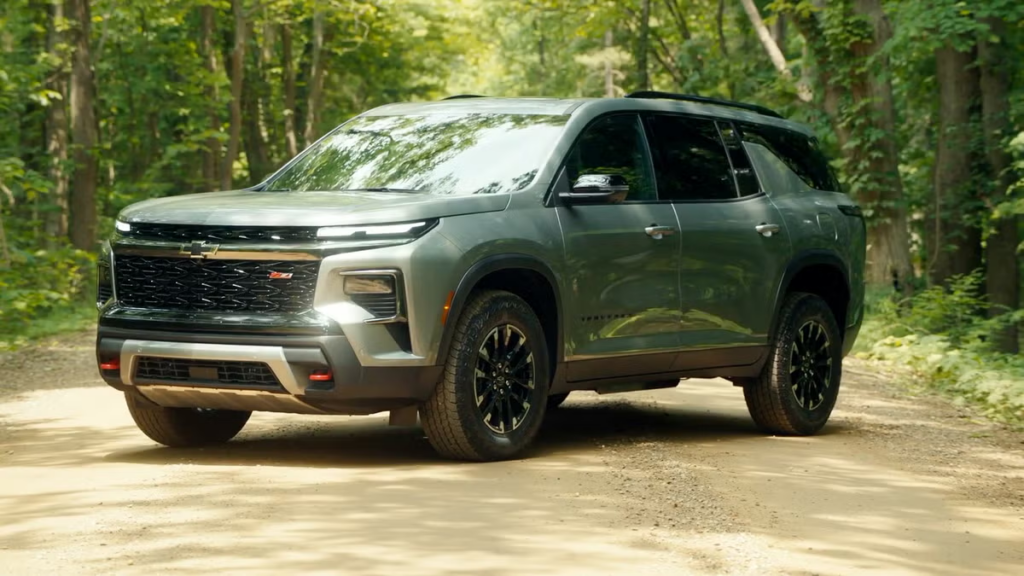
Chevrolet has also introduced the Z71 trim, a nod to its more adventurous brethren. This package boasts enhanced off-road capabilities, including skid plates, a specially tuned AWD system, dedicated terrain modes, all-terrain tires, and an increased ground clearance of one inch, making it the most trail-capable Traverse to date.
Inside, the cabin continues its tradition of vastness, though a slight reduction in third-row legroom by about an inch has been noted compared to the previous generation. The technological leap is substantial, featuring a colossal 17.7-inch infotainment touchscreen and an 11-inch digital instrument cluster. The Traverse now utilizes a Google-based infotainment system, lauded for its comprehensive features and user-friendly interface. Nearly every function within the SUV is designed with intuitive operation in mind.
The 2025 model year sees the reintroduction of the High Country trim, enhancing the Traverse’s luxury quotient with 22-inch wheels, trailering equipment, premium leather seating, and an upgraded suspension. At launch, the new Traverse started with an MSRP of $40,800, excluding the $1,995 destination charge, with the more rugged Z71 trim beginning at $48,900.
Second Generation (2018-2023): Refinement and Enhanced Reliability
The 2018 model year marked a comprehensive redesign for the Chevrolet Traverse, ushering in a more muscular aesthetic, updated technology, and, crucially, significantly improved reliability. The styling shifted towards Chevrolet’s truck-inspired design language, featuring squarer wheel arches and an upright stance, a departure from the smoother lines of its predecessor. This generation also saw an increase in wheelbase by two inches and a reduction in overall weight by 111 pounds.
For the first time, Chevrolet offered buyers a choice of powertrains: a V6 and a four-cylinder. The primary engine remained a 3.6-liter V6, but this updated design produced a more robust 310 horsepower and 266 pound-feet of torque. The 2.0-liter turbocharged four-cylinder was available only in the front-wheel-drive RS trim for the 2018 and 2019 model years, delivering 257 horsepower and a respectable 295 pound-feet of torque, proving capable despite the Traverse’s substantial size.
Trim levels were diverse, including L, LS, LT Cloth, LT Leather, 3LT, RS, Premier, and High Country, with most available in either front-wheel or all-wheel drive. The High Country trim approached GMC-level luxury, incorporating features like a chrome grille, power-adjustable front seats, a power-folding third-row seat, a Wi-Fi hotspot, roof rails, a hands-free power liftgate, and a heated steering wheel. The RS trim adopted a sportier persona, featuring 20-inch black aluminum wheels and premium tech like a Bose audio system and an HD surround vision camera. A rear-seat entertainment system was also an option until 2021.
The LT Cloth and LT Leather trims were largely identical, differing only in their upholstery. The LS, as the base model, offered solid value with standard amenities like GM’s Teen Driver Mode and heated exterior mirrors. The four-cylinder engine was discontinued after the 2019 model year due to sluggish sales.
A significant update arrived with the 2021 model year, making many driver-assistance features standard. These included automatic emergency braking with pedestrian detection, forward collision warning, lane keep assist with lane departure warning, and automatic high beams. Higher trims like the RS and Premier gained access to adaptive cruise control.
While not as overtly luxurious as some rivals, the second-generation Traverse excelled in its user-friendly technology and comprehensive standard comfort and convenience features. The standard 7-inch color touchscreen (optional 8-inch) provided access to an infotainment system featuring wireless Apple CarPlay and Android Auto, Bluetooth, six USB ports, and a six-speaker sound system. Three-zone automatic climate control and keyless entry with push-button start were also standard.
Despite its midsize classification, the Traverse offered a usable third row and impressive cargo capacity, boasting 98.2 cubic feet with all seats folded – a figure competitive with some minivans. Excellent outward visibility and a suite of standard and available safety features, including blind-spot monitoring, rear cross-traffic alerts, and automatic emergency braking, further bolstered its appeal.
Reliability saw a notable improvement over the first generation. While the 2018 model year received some criticism for engine and electrical issues, subsequent years demonstrated better performance, placing it around the average for its class, a significant step up from its predecessors. For buyers seeking a pre-owned Chevrolet Traverse, models from 2019 to 2021 in good condition with under 80,000 miles typically ranged from $18,000 to $26,000 for LT and RS trims. Premier and High Country models, with their added luxury, commanded higher prices, with late-model High Country versions potentially reaching up to $48,000.
First Generation (2009-2017): The Pioneering Years
The original Chevrolet Traverse, introduced as a 2009 model, shared its platform with the GMC Acadia, Saturn Outlook, and Buick Enclave, establishing GM’s presence in the burgeoning three-row crossover segment. It was powered by a 3.6-liter V6 engine paired with a six-speed automatic transmission. The LTZ trim was the sole recipient of the V6’s full 288 horsepower and 270 pound-feet of torque, while lower trims experienced a slight reduction due to a single exhaust system.
Fuel economy, with a combined rating of 19 mpg for both FWD and AWD, was not its strong suit compared to more efficient contemporaries, but its utility was undeniable. It could tow up to 5,200 pounds and offered a cavernous 116.4 cubic feet of maximum cargo volume, a figure that still impresses today. Even with all seats in place, there were 24.4 cubic feet of cargo space behind the third row, ample for groceries. The third-row legroom of just over 33 inches was generous for its era.
Seating configurations varied: LS and LT1 trims came standard with eight-passenger capacity. The LT2 and LTZ, equipped with second-row captain’s chairs, could opt for a bench seat to accommodate seven passengers. The base LS trim was sparsely equipped with power accessories, A/C, and a six-speaker stereo. Moving up to the LT1 added heated mirrors and rear parking sensors. The LT2 introduced tri-zone climate control, a 10-speaker Bose stereo, a power liftgate, and a rearview camera. The range-topping LTZ offered leather upholstery, heated and ventilated power front seats, driver memory, Bluetooth, and remote start. Many premium features, like a trailering package, navigation, dual sunroofs, and a rear-seat DVD system, were available as options.
Despite its early success and popularity as a family vehicle, the first-generation Traverse developed a reputation for inconsistent long-term reliability. Issues with the electrical system, power steering, engine, and the 6T75 six-speed automatic transmission were frequently reported. While some of these problems were addressed in later model years, comprehensive reviews from sources like Consumer Reports and CarComplaints generally rate this generation unfavorably for dependability.
Consequently, early Traverse models are now exceptionally affordable. Well-maintained examples with under 100,000 miles can often be found for $8,000 to $13,000. Later models from 2014 onwards typically range from $13,000 to $17,000, with higher trims and exceptionally low-mileage examples commanding more. While offering substantial space for the price, thorough pre-purchase inspection and careful selection are strongly advised due to potential repair costs.
Key Considerations for Chevrolet Traverse Buyers
When evaluating a Chevrolet Traverse, especially a pre-owned model, several factors warrant close attention:
Reliability Rankings: Focus on model years with improved reliability scores. The second generation (2018-2023) generally outperforms the first generation. Within the second generation, later model years (2020 onwards) tend to be more dependable. For the third generation, it’s too early to establish long-term reliability trends, but initial reports suggest a strong start.
Powertrain: The 3.6L V6 engine in the second generation is generally considered robust, though issues were noted in early models. The turbocharged four-cylinder in the third generation offers more power and efficiency but represents a newer technology for the Traverse platform.
Trim Levels: Consider your needs. The LS and LT trims offer excellent value for essential family transport. The RS and Premier trims add sportier styling and more premium features. The High Country elevates the Traverse to near-luxury status. The Z71, unique to the third generation, appeals to those seeking enhanced off-road capability.
Features and Technology: Newer models boast significantly more advanced technology, including larger screens, wireless smartphone integration, and a wider array of driver-assistance systems. Decide which features are essential for your driving experience.
Mileage and Condition: For used vehicles, prioritize models with lower mileage and a documented maintenance history. Inspect for any signs of wear and tear, especially in the interior and on the suspension components, which have been known problem areas in earlier generations.
Cost of Ownership: Factor in potential repair costs, especially for older models with known reliability concerns. Purchasing an extended warranty for a pre-owned Traverse can offer considerable peace of mind.
The Smartest Chevrolet Traverse Years to Buy
Based on reliability data, owner reviews, and overall value, the 2019-2023 Chevrolet Traverse models stand out as the most judicious choices for savvy buyers. These second-generation vehicles strike a compelling balance between improved dependability, modern features, and accessible pricing on the used market. They offer the spaciousness and comfort expected of the Traverse while mitigating many of the significant reliability concerns that plagued the first generation. While the latest third-generation models represent the cutting edge of technology and design, their higher price points and unproven long-term reliability make them a less compelling value proposition for budget-conscious shoppers at this moment.
Maximizing Your Chevrolet Traverse Investment
The Chevrolet Traverse continues to be a formidable contender in the three-row SUV segment, particularly for families prioritizing space and comfort. By understanding the historical performance of each generation, focusing on model years with proven reliability, and carefully assessing your individual needs and budget, you can secure a vehicle that delivers exceptional value and serves your family reliably for years to come.
Whether you’re drawn to the sheer practicality of the second generation or the advanced technology of the all-new third generation, the Traverse offers a compelling proposition. We encourage you to explore current listings, schedule test drives of your preferred model years, and consult with trusted automotive professionals to ensure you find the perfect Chevrolet Traverse that aligns with your family’s lifestyle and your pursuit of an outstanding driving experience. Your journey to finding the ideal spacious and capable family vehicle begins with informed research and a clear understanding of what each Chevrolet Traverse generation has to offer.