
Navigating the Trail: Your Expert Guide to Buying a Subaru Outback
For decades, the Subaru Outback has carved out a unique niche in the automotive landscape. More than just a car, it’s been a symbol of adventure, practicality, and enduring capability for countless American families and solo explorers alike. While the market now labels it a crossover, its roots trace back to a clever evolution of the Subaru Legacy wagon, first appearing as an option package in 1995. Subaru, a pioneer in all-wheel-drive (AWD) technology long before it became mainstream, leveraged its heritage during a period of declining sales in the late 80s and early 90s. The Outback emerged as a direct response, transforming a capable Legacy wagon into something with enhanced ground clearance and a distinctly rugged aesthetic, perfectly timed to capitalize on the burgeoning consumer fascination with SUVs.
This innovative approach wasn’t just a one-off. Within a year, the Outback received a modest lift kit, further enhancing its go-anywhere appeal. The core recipe was deceptively simple: take Subaru’s proven AWD system, amplify its off-road prowess with increased ride height and suspension refinements, and wrap it in a visually appealing package. The result was an immediate hit, resonating with American buyers who craved the versatility of an SUV but perhaps found traditional sport-utility vehicles a bit too cumbersome or ostentatious. The Outback offered a compelling blend of car-like comfort and genuine trail-ready substance, establishing a reputation for spontaneous road trips and outdoor excursions. Its popularity even led to the introduction of a smaller sibling, the Outback Sport, based on the compact Impreza, and for a period, even a sedan variant, the Legacy SUS, often badged as an Outback, was available. By 1999, AWD was so integral to Subaru’s identity, heavily fueled by the Outback’s success, that it became standard across the entire lineup.
As the years progressed, the Outback continued to evolve, gradually distancing itself from the Legacy platform. Its wagon-like proportions morphed into something decidedly more crossover-like, a design direction so successful that by the late 2010s, the very design of the Legacy sedan was influenced by the Outback’s demand for increased ride height and ruggedness. Throughout its history, the Outback has often served as Subaru’s technological flagship. The advanced EyeSight suite of driver-assistance systems debuted on the Outback in 2008, predating similar offerings from many competitors. Its AWD system has undergone continuous refinement, showcasing Subaru’s commitment to delivering dependable traction in diverse conditions. The introduction of the even more rugged Outback Wilderness trim in 2021 further underscored this capability, a move that subsequently inspired similar Wilderness variants for the Forester and Crosstrek. Today, the Subaru Outback remains a benchmark for practicality, spaciousness, and light off-road prowess, boasting generous ground clearance and sophisticated terrain management systems.
However, no vehicle is without its quirks. The continuously variable transmissions (CVTs) adopted by Subaru over the last decade, while offering smooth operation and decent fuel economy, can be complex and costly to repair should issues arise. Subaru’s signature horizontally-opposed Boxer engines, while known for their low center of gravity and smooth operation, can be more maintenance-intensive than conventional inline engines. Historically, head gasket issues have been a concern for some Subaru powertrains, and while modern iterations have improved, it’s a factor to consider, particularly with older models. Fuel economy, while competitive for AWD vehicles, might not always match the most frugal front-wheel-drive alternatives. Furthermore, Subaru has yet to offer a hybrid variant of the Outback, a feature increasingly sought after by environmentally conscious buyers. And as with any vehicle regularly used for off-pavement adventures, more components are subjected to wear and tear compared to a sedan or a purely on-road crossover.
Despite these considerations, the Subaru Outback garners immense owner loyalty. Its reputation for safety, capability, and its unique blend of attributes makes it a compelling choice for those who lead active lifestyles. This guide aims to provide you with an in-depth look at each generation of the Subaru Outback, offering expert insights and advice to help you find the perfect used model that aligns with your needs and budget. Whether you’re searching for a budget-friendly adventurer or a feature-rich family hauler, understanding the nuances of each generation is key to making an informed decision.
Decoding the Generations: A Deep Dive into Subaru Outback History
Seventh Generation (2026-Present): The Future Unveiled
The latest iteration of the Subaru Outback, introduced for the 2026 model year, presents a more angular and robust aesthetic. While retaining familiar proportions, this generation embraces bolder design cues, including updated lighting signatures and durable, textured lower body cladding. The roof rack system sees a significant upgrade, now capable of supporting a 220-pound lateral load, making it ideal for accessories like rooftop tents or even a simple clothesline for extended trips.
Inside, the cabin offers enhanced comfort and practicality. Door bottle holders now accommodate larger 32-ounce containers, and a slightly taller roofline (a 2-inch increase) translates to improved headroom. Cargo capacity sees a boost of 2 cubic feet, with an additional 2 inches of vertical space. Technological advancements are front and center, with an all-new 12.1-inch infotainment display complemented by a 12.3-inch digital instrument cluster, both running updated software for a more intuitive user experience.
Safety receives a substantial overhaul with the introduction of Emergency Stop Assist with Safe Lane Selection. This innovative feature can detect if a driver becomes unresponsive while using adaptive cruise control, safely guiding the vehicle to the shoulder and alerting emergency services. On select highways, hands-free driving with driver supervision is now possible at speeds up to 85 mph. The EyeSight camera system features a wider field of view, enhancing its ability to detect pedestrians and cyclists, and now incorporates haptic feedback for alerts.
Under the hood, the 2.5-liter Boxer engine has been revised to produce 180 horsepower and 178 pound-feet of torque. For those seeking more power, the XT models carry over the potent 2.4-liter turbocharged engine, delivering 260 horsepower and 277 pound-feet of torque. The starting MSRP for the 2026 Subaru Outback is $34,995 (excluding destination), reflecting a notable increase from the outgoing model. Subaru has streamlined the lineup by dropping the base trim, with the Premium level now serving as the entry point, offering more standard equipment from the outset.
Sixth Generation (2020-2025): Refinement and Expansion
The sixth-generation Subaru Outback, launched for the 2020 model year, presented a subtly revised exterior that belied significant under-the-skin advancements. The formerly optional six-cylinder engine was retired, replaced by a potent 2.4-liter turbocharged four-cylinder (the “XT” engine), offering 260 horsepower and 277 pound-feet of torque. This powerplant proved to be both more powerful and more fuel-efficient than its predecessor. Standard models continued with a revised 2.5-liter four-cylinder engine, producing 182 horsepower and 176 pound-feet of torque. Both engines were paired with a new continuously variable transmission (CVT) featuring an eight-speed manual mode, and AWD remained standard.
The initial trim structure included 2.5i, Premium, Limited, Touring, Onyx Edition XT, Limited XT, and Touring XT. The XT trims featured the turbocharged engine and additional equipment. A significant upgrade in infotainment arrived with an available 11.6-inch portrait-style touchscreen, integrating Apple CarPlay and Android Auto. Subaru’s EyeSight suite of safety features, a driver-distraction warning system, high-beam assist, and a front-view camera were also notable additions. Base models featured dual 8-inch screens with a more fundamental interface. For the first time, a Wi-Fi hotspot was offered.
The 2022 model year saw the highly anticipated debut of the Outback Wilderness. This trim line represented Subaru’s most off-road-focused factory offering, boasting 9.5 inches of ground clearance, Yokohama Geolander all-terrain tires, and a specially tuned suspension and terrain management system. Its rugged aesthetics, complete with aggressive cladding and gold accents, along with specialized bumpers for improved approach and departure angles, and a robust roof rail system capable of supporting 700 pounds, clearly set it apart. While lacking some of the luxury appointments of the Limited XT and Touring XT, it came standard with the turbocharged engine.
A 2023 cosmetic refresh brought revised black cladding and a front fascia inspired by the Wilderness model. In-car cameras for the EyeSight system were upgraded, and the availability of the turbocharged engine was expanded. The Outback also became the first Subaru to integrate what3words technology, allowing location referencing via three words. For 2024, the Outback Wilderness received front fascia updates, and a heated steering wheel became available on Onyx Edition, Onyx Edition XT, and Wilderness trims. The Onyx Edition also gained a moonroof and reverse automatic emergency braking as standard. For 2025, the Limited trim received a moonroof, heated steering wheel, driver-attention monitoring, and built-in navigation.
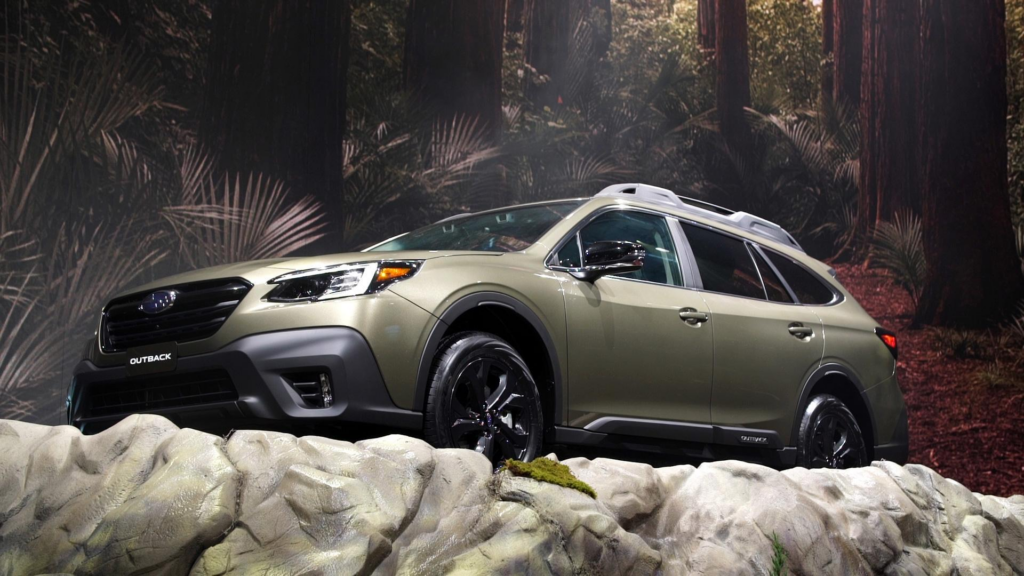
The starting price for the 2020 model was $26,645 (excluding destination). Remarkably, Subaru has maintained the base price at $29,995 for 2025, making the Outback one of the most accessible vehicles offering this combination of size and capability. The inclusion of numerous active safety systems, often optional on more expensive vehicles, further enhances its value proposition.
Fifth Generation (2015-2019): The Crossover Transition
The fifth-generation Outback, launched for the 2015 model year, marked a definitive shift, with Subaru officially designating it a crossover rather than a wagon. Styling evolved with a sportier, more aerodynamic design, yet remained evolutionary. The manual transmission, once a staple but rarely ordered, was discontinued. More previously optional safety systems, such as automatic emergency braking and blind-spot assist, became standard on a wider range of trims.
The standard engine was a 2.5-liter four-cylinder producing 175 horsepower and 174 pound-feet of torque. The 3.6R Limited trim featured a 3.6-liter six-cylinder engine delivering 256 horsepower and 247 pound-feet of torque. While the six-cylinder offered more power, its less impressive fuel economy and higher price point limited its popularity. AWD remained standard, and a continuously variable transmission (CVT) with a six-speed manual mode was also standard, mirroring the later years of the fourth generation. Subaru’s X-Mode terrain system, designed to enhance performance in slippery conditions, along with hill-descent control and hill-start assist, became standard. The Limited trims received exclusive Stablex suspension dampers for a firmer, more controlled ride. Notably, all Outbacks in this generation adopted a new double-wishbone rear suspension design and a front suspension cradle, significantly improving ride comfort and reducing cabin noise.
The interior received a styling update, though infotainment saw only modest changes. Base models featured a 6.2-inch touchscreen, while higher trims had a 7-inch unit, both running a user-friendly but basic interface. In 2016, Starlink connected services were added to upper trims, and lane-keep assist joined the EyeSight system. A year later, the interior was updated, and new standard 6.5-inch and optional 8-inch infotainment screens were introduced with improved software and graphics. The 8-inch screen marked the first appearance of Apple CarPlay and Android Auto.
The EyeSight driver-assist suite, initially exclusive to upper trims, included adaptive cruise control, automatic emergency braking, and lane-departure warning. Blind-spot monitoring, lane-change assist, and rear cross-traffic alert were also limited to higher trims until 2019, when the entire suite became standard across the Outback lineup.
Common complaints for this generation often center on the CVT’s drone at highway speeds, which some found to be less responsive. However, it is generally a quieter and more refined vehicle than its predecessors, and typically free of major mechanical issues beyond those common to all Outbacks. It offers comfortable and capacious seating, with improved rear-seat space.
Higher trim levels, especially those equipped with EyeSight, represent better value. The 2019 model year is particularly attractive for its standard EyeSight suite. Most fifth-generation Outbacks can be purchased for under $25,000, though they tend to hold their value well. Expect to find most models ranging from $16,000 to $24,000, including the more powerful 3.6R variants. Finding a well-maintained example with under 80,000 miles for under $20,000 should be achievable.
Fourth Generation (2010-2014): The Crossover Blueprint
The fourth-generation Subaru Outback marked a significant divergence from its predecessors. The sedan variant was discontinued, and conventional automatic transmissions were replaced by continuously variable automatic transmissions (CVTs) on four-cylinder models. The styling adopted a decidedly more crossover-like appearance, setting a design template that subsequent generations have largely followed. This generation’s vehicles maintain a contemporary look even when parked alongside newer Outbacks. The fourth-gen Outback was taller and slightly heavier than the third generation, which impacted handling slightly but also contributed to increased interior space thanks to a longer wheelbase and wider track, despite being shorter in overall length than the 2009 model.
The fundamental mechanical recipe remained consistent: standard AWD with advanced traction modes and available four- and six-cylinder horizontally-opposed engines. For 2010, the Outback was offered in six trim levels: 2.5i, 2.5i Premium, 2.5i Limited, 3.6R, 3.6R Premium, and 3.6R Limited.
The standard 2.5-liter naturally aspirated four-cylinder engine produced 170 horsepower and an equal amount of torque. The 3.6-liter flat-six engine offered 256 horsepower and 247 pound-feet of torque. While both engines could be paired with a six-speed manual transmission, the majority of four-cylinder sales utilized the new Lineartronic CVT. Six-cylinder models still offered a conventional five-speed automatic transmission.
In-car technology was relatively basic, but Subaru did offer navigation and a backup camera, both displayed on an 8-inch touchscreen—a considerable size for the era. Traction and stability control were available but not standard on all models.
The 2013 model year brought significant updates, including a restyled front fascia. The 2.5-liter four-cylinder engine received a power bump to 173 horsepower and 174 pound-feet of torque. Subaru also tailored the AWD system to each transmission: the manual gearbox received a continuous AWD system, the CVT was paired with an active torque split AWD, and the five-speed automatic featured a variable torque distribution AWD system. All models maintained 8.7 inches of ground clearance, suitable for trail use.
The 2013 model year also introduced the Subaru EyeSight driver-assist system, featuring adaptive cruise control, automatic braking, and lane-departure warning, initially on the Outback Limited. By 2014, EyeSight became standard on Outback Premium models.
While some reliability trackers give this generation mixed reviews, particularly concerning electrical issues, they remain relatively inexpensive. Clean fourth-generation Outbacks with under 120,000 miles can be found for as little as $8,000. Searches for low-mileage 3.6R models with desirable options revealed prices under $17,000. The six-cylinder model is rarer and less fuel-efficient but offers a more engaging driving experience. Higher trim 2013 and 2014 models often provide more features without a significant price increase, making them excellent value. Manual transmission models, favored by some enthusiasts, typically command a modest premium.
Third Generation (2005-2009): Stylish Evolution
Debuting in early 2004 as a 2005 model, the third-generation Outback offered a more stylish departure from its predecessors. Subaru experimented with more aggressive visuals, resulting in a distinctive, sleeker shape. A sedan version was still available, mirroring the lifted suspension of the wagon, but slow sales led to its discontinuation in 2007, making them quite rare today.
Reviewers praised the third-gen Outback for its refined ride quality and robust standard features. However, the rear-seat legroom (33.9 inches) was the most cramped across all Outback generations.
For 2005, three engine options were available: a 2.5-liter four-cylinder (168 horsepower, 166 pound-feet of torque), an optional 2.5-liter turbocharged four-cylinder (“XT”) producing 250 horsepower and 250 pound-feet of torque, and a 3.0-liter six-cylinder engine with 250 horsepower and 219 pound-feet of torque. Both a five-speed manual and automatic transmission were offered.
In 2006, the naturally aspirated 2.5-liter engine received a power increase to 175 horsepower, and a navigation system became available. The following year saw revised trim levels, but no significant mechanical changes. For 2009, stability control was added to all trims, and the long-running L.L. Bean model was replaced by the Limited trims.
While equipment differences are less pronounced in these older models compared to newer generations with vast variations in infotainment and safety tech, L.L. Bean and Limited models tend to be better equipped, often featuring wood-and-leather steering wheels, upgraded interiors, navigation, and even USB ports.
Consumer Reports expressed concerns about the reliability of the early years of this generation, so thorough inspection is recommended. However, the engines are generally considered more durable than those in the first two generations. Maintenance records are crucial, as timing belt and head gasket renewals are important services for these Outbacks. Due to their age and lower sales during the financial crisis, these Outbacks are relatively rare. Prices typically range from $5,000 to $10,000, with even the nicest examples rarely exceeding this. Manual transmission and sedan versions might command slightly higher prices.
Second Generation (2000-2004): Establishing the Identity
Officially spun off from the Legacy, the second-generation Outback was a completely new model for 2000, maintaining its predecessor’s popularity. The analogous “Legacy SUS” sedan was renamed the Outback sedan and shared the same mechanical components. Styling became more contemporary, and attractive two-tone color schemes were introduced, but the core formula remained largely unchanged.
The standard engine was a 2.5-liter version of Subaru’s well-known “EJ25” engine, now producing 165 horsepower and 166 pound-feet of torque. In 2001, the L.L. Bean edition debuted, offering enhanced luxury features and, notably, a new 3.0-liter six-cylinder engine (the “EZ30”) with 212 horsepower and 210 pound-feet of torque. This engine design formed the basis for Subaru’s six-cylinder variants for the next 18 years.
AWD remained standard, and ground clearance increased to 7.3 inches. Four-cylinder models were available with a four-speed automatic or a five-speed manual transmission, while six-cylinder models were automatic-only. Styling was refreshed for 2003, but the core mechanics saw minimal changes throughout this generation’s lifespan.
L.L. Bean models were generously equipped with features like dual-zone climate control, CD changers, leather seats, dual moonroofs, a 200-watt McIntosh stereo, and an optional Vehicle Dynamics Control (VDC) system. Other Outback models, while comfortable, offered fewer modern amenities.
Given the age of these vehicles, meticulously reviewing maintenance records is crucial for a safer purchase. Consumer Reports rated the 2000 and 2001 models below average for reliability, though they are simpler and generally durable vehicles. Rust (requiring careful inspection) and head gasket issues are common concerns. Finding these models can be challenging, but they are typically very affordable. Most second-generation Outbacks, excluding the nicest 3.0-liter models and sedans, sell for between $4,500 and $8,000.
First Generation (1995-1999): The Genesis
The Subaru Outback began its journey as a trim package on the 1995 Subaru Legacy. However, it was the following year, 1996, that its now-familiar formula truly crystallized. The Legacy, introduced in 1988 and in its second generation by 1995, already boasted a reputation for its rally-car prowess and all-terrain capabilities. The Outback was conceived to imbue the model with an image as rugged as its components.
Initially, this involved visually enhanced bumpers with integrated fog lights, different wheels, and a standard two-tone color scheme featuring dark gray paint on the lower body panels. Underneath, it retained many standard Legacy components, including an anemic 2.2-liter four-cylinder engine producing 135 horsepower and 140 pound-feet of torque. Power was sent to all four wheels via a four-speed automatic or a five-speed manual transmission.
While the aesthetic changes were effective, Subaru responded to early criticisms regarding engine power and limited ground clearance by improving both. In 1996, the Outback received a 2.5-liter engine with 155 horsepower and 155 pound-feet of torque, larger rally-style headlights, and a suspension lift that provided 7.8 inches of ground clearance. At the time, this was a significant amount for a passenger vehicle, with only AMC’s Eagle four-wheel-drive from the 1980s offering a comparable concept.
This combination struck a chord with consumers, and with the help of Australian actor Paul Hogan in marketing campaigns, it revitalized Subaru’s flagging U.S. sales. Subaru soon applied this successful formula to the smaller Impreza, creating the Outback Sport (the precursor to today’s Crosstrek), with similar positive results. In 1997, a Limited trim was introduced, adding niceties to the interior, but the car remained largely unchanged for the 1998 and 1999 model years.
In 1998, Subaru also introduced the “Legacy SUS” (Sport Utility Sedan), which essentially applied the Outback’s rugged recipe to a Legacy sedan. This model would later be integrated into the dedicated Outback lineup in the second generation.
These early Outbacks were commendable for their era but are known for potential engine issues, primarily weak head gaskets and aging timing belts, especially on the 2.5-liter variants. Many enthusiasts have undertaken engine swaps with later, more powerful units, though some opt for the older, less powerful 2.2-liter. Thorough inspection and maintenance records are paramount. The good news is that these early models can be found for under $5,000, though collector interest is only beginning to emerge.
Essential Considerations for the Used Subaru Outback Buyer
When embarking on your used Subaru Outback purchase, several key factors deserve your meticulous attention to ensure you’re acquiring a reliable and satisfying vehicle.
Reliability and Maintenance: While most Subaru Outbacks generally receive “average” reliability ratings from automotive data aggregators, their maintenance requirements can be slightly higher than some competitors like Toyota Camrys or RAV4s. This is often attributed to the inherent complexity of AWD systems and Subaru’s Boxer engines. Common wear items include head gaskets and timing belts, particularly on older models, which can be significant repair expenses. Prioritizing vehicles with comprehensive maintenance records is paramount. Look for evidence of regular oil changes, coolant flushes, and timing belt replacements (if applicable to the generation you’re considering).
The CVT Factor: Over the past decade, Subaru has widely adopted Continuously Variable Transmissions (CVTs). While these transmissions offer smooth acceleration and contribute to fuel efficiency, they can be more complex and expensive to repair if issues arise. If you’re considering a model with a CVT, it’s advisable to have it inspected by a mechanic familiar with Subaru CVTs. Pay attention to any unusual noises, hesitations, or slipping during your test drive.
Engine Health: Subaru’s horizontally-opposed Boxer engines are distinctive for their smooth operation and low center of gravity. However, certain older generations (particularly the first and second generation 2.5-liter engines) have a documented history of head gasket failures. While later generations have seen improvements, it’s wise to research the specific engine in the model year you’re interested in and be aware of potential symptoms of head gasket issues, such as coolant loss, white smoke from the exhaust, or oil in the coolant.
Fuel Economy: While the Outback’s AWD system enhances its capability, it generally results in slightly lower fuel economy compared to front-wheel-drive vehicles of similar size. This is a trade-off for its all-weather and off-road prowess. Research the EPA estimates for the specific model year and engine you’re considering to ensure it aligns with your driving needs and budget.
All-Wheel Drive System: The Subaru symmetrical all-wheel-drive system is a cornerstone of the Outback’s appeal. Ensure that it is functioning correctly. During your test drive, listen for any unusual noises or vibrations from the drivetrain. If possible, test the vehicle in varying conditions to assess its traction capabilities.
Features and Trim Levels: The Outback has been offered in a wide array of trim levels across its generations, each with varying levels of comfort, technology, and safety features. Higher trim levels often include desirable amenities like leather upholstery, premium audio systems, navigation, sunroofs, and advanced driver-assistance systems (ADAS) such as EyeSight. Consider which features are most important to you and factor this into your search.
Cost of Ownership: Beyond the initial purchase price, factor in the ongoing costs of ownership, including insurance, fuel, routine maintenance, and potential repairs. Researching the typical cost of parts and labor for specific repairs on the model year you’re interested in can help you budget effectively.
High-CPC Keywords to Consider in Your Search:
Used Subaru Outback for sale near me: This local intent keyword is crucial for buyers actively looking to purchase.
Subaru Outback reliability ratings: Understanding long-term dependability is a major concern for buyers.
Best used Subaru Outback years: Many buyers seek recommendations for the most dependable model years.
Subaru Outback price range: Understanding market value is essential for negotiation.
Subaru Outback cargo space: A key selling point for this vehicle.
Subaru Outback ground clearance: Important for off-road enthusiasts.
Subaru Outback towing capacity: Relevant for buyers who need to haul trailers.
Subaru Outback vs. Forester: Direct comparison searches indicating buyer consideration.
Subaru Outback CVT issues: Addresses common concerns buyers might have.
Subaru Outback warranty used: Information about extended warranties for pre-owned vehicles.
Subaru Outback AWD system: Focuses on a core feature.
Subaru Outback engine problems: Highlights potential concerns buyers research.
Buy a Subaru Outback: General purchase intent keyword.
Subaru Outback Outback Wilderness: Specific popular trim level.
Subaru Outback safety features: Emphasizes a critical aspect for families.
Affordable Subaru Outback: Targets budget-conscious buyers.
By focusing on these key considerations and integrating relevant search terms into your research, you’ll be well-equipped to navigate the used Subaru Outback market and find a vehicle that perfectly suits your adventurous spirit and practical needs.
Your Next Step Towards Adventure:
The Subaru Outback offers a unique blend of capability, comfort, and iconic ruggedness that has resonated with drivers for decades. Whether your adventures call for navigating city streets with confidence or venturing off the beaten path, understanding the history and nuances of each generation is your first step toward finding the perfect used Subaru Outback. Now that you’re armed with this expert knowledge, begin your search for a pre-owned Subaru Outback that aligns with your lifestyle and budget. Explore local dealerships, browse online marketplaces, and most importantly, take potential candidates for thorough test drives. Your next Subaru Outback awaits to unlock a world of possibilities.