
Your Ultimate Guide to Buying a Chevrolet Corvette: Unpacking Value, Reliability, and the Best Years to Own
For over seven decades, the Chevrolet Corvette has stood as a beacon of American automotive performance and aspirational ownership. More than just a car, it’s a cultural icon, a testament to engineering prowess, and a dream machine that has consistently delivered exhilarating driving experiences at a price point that often astounds the competition. As an industry expert with a decade immersed in the automotive landscape, I’ve seen firsthand how the Corvette has evolved, from its humble beginnings as an answer to European rivals to its current status as a bona fide supercar. This comprehensive guide will navigate you through the labyrinth of options, helping you make an informed decision when purchasing your very own Chevrolet Corvette. We’ll delve into cost considerations, long-term reliability, and pinpoint the model years that represent the pinnacle of value and performance, ensuring your investment in this legendary American sports car is a wise one.
The allure of the Chevrolet Corvette began in 1953, a direct response to the growing popularity of European sports cars like the Jaguar XK-120 and MG TD, as well as unique transatlantic collaborations. Chevrolet’s initial vision was an American interpretation of the exotic sports roadster, wrapped in a groundbreaking fiberglass body. While undeniably stylish, it wasn’t an immediate commercial triumph. The true genesis of the performance-oriented Corvette we know today arrived in 1955 with the introduction of Chevrolet’s potent Small Block V8 engine. This powerplant fundamentally altered the car’s character, injecting the necessary vigor to compete. The subsequent complete redesign in 1963 solidified the Corvette’s enduring formula: potent V8 engines, rear-wheel drive, a lightweight chassis, and robust, enduring mechanical components. This foundational design blueprint remained remarkably consistent for nearly six decades, right up until the revolutionary C8 generation.
Throughout the latter half of the 20th century, the Corvette carved out its niche as a “working-class hero.” It democratized exotic car speed and styling, offering a tantalizing taste of high-performance motoring without the prohibitive price tag. Even as emissions regulations curtailed the era of big-block V8s and convertible availability, the Corvette persevered, retaining its sporty essence. By the late 1990s, with models like the ZR1 and Z06, the Corvette was no longer just competing with foreign sports cars; it was actively challenging and often outperforming established titans from Ferrari, Porsche, Jaguar, and Aston Martin. This aggressive performance trajectory has only intensified with each subsequent generation.
The automotive world witnessed a seismic shift in 2020 with the introduction of the C8 Chevrolet Corvette. After decades of conceptual exploration and engineering deliberation, Chevrolet finally embraced the mid-engine layout, producing a machine so visually striking and dynamically capable that it’s often compared to the likes of Ferrari. The C8 represents not just an evolution but a revolution, delivering the best performance and fastest acceleration in Corvette history. This groundbreaking platform has since been expanded with the potent Z06 variant and the innovative E-Ray hybrid, further pushing the boundaries of what an American sports car can be.
Whether you’re drawn to the timeless elegance of the first-generation C1 models from the 1950s or the cutting-edge technology of the latest C8, there’s a Chevrolet Corvette to capture every enthusiast’s heart. Even older models retain a strong following and significant classic car appeal. This guide aims to provide a comprehensive overview of each Corvette generation, offering practical advice on purchasing, highlighting key considerations for reliability and cost of ownership.
Across all Chevrolet Corvette generations, certain core tenets endure: remarkable reliability, a tendency for owners to meticulously care for their vehicles, and a compelling value proposition. While Corvettes are no longer considered inexpensive, they consistently offer a level of performance and engagement that significantly undercuts the price of comparable vehicles from true exotic marques. While their interiors may not exude the same level of opulence as a Ferrari or Aston Martin, and their construction is often more utilitarian, the driving thrill is undeniable. Many Corvettes are capable of speeds well in excess of 150 mph, and even more importantly, they possess a unique charm that resonates deeply with their owners.
Frequently Asked Questions for the Discerning Corvette Buyer
Which Chevrolet Corvette Years Are the Best Investments?
The Corvette’s long-standing reputation for reliability is largely due to its use of proven, robust mechanical components, such as the legendary Chevy Small Block V8. This inherent durability means that many Corvette generations are inherently reliable. Furthermore, the Corvette community is passionate; owners typically fall into two categories: meticulous caretakers or those who truly drive their cars. The latter often makes it easier to assess a pre-owned vehicle’s history. Looking at more modern Corvettes, the C5 and C6 generations are widely regarded as paragons of reliability. The C8, with its more complex systems, has also proven remarkably dependable in its early years. While the C7 is a capable machine, its initial model years (2014-2015) garnered some criticism for reliability concerns, as noted by various automotive review indexes. Consumer Reports has offered a more nuanced perspective, rating 2014 models favorably but subsequent C7 years as average. For those venturing into older models, the 1980s-era C4 Corvettes, despite their dated interiors and often modest power output from the factory, can be reliable if well-maintained, though they are less desirable for outright performance seekers compared to later iterations.
What Are the Worst Chevrolet Corvette Years to Consider?
As mentioned, the initial C7 models (2014-2015) experienced some reliability headwinds. The C4 generation from the 1980s, particularly the earlier models, often lacked the power of their predecessors and successors. Their interiors featured abundant plastic, which, while durable, now appears distinctly dated. The 1980 and 1981 models are generally considered the slowest from the factory, though many have since been modified to improve performance. For the performance purist, these years are generally overlooked unless a specific project car is desired.
Is a Used Chevrolet Corvette a Good Value Proposition?
Absolutely. While certain rare and highly collectible Corvettes command astronomical prices, the vast majority of used Corvettes represent exceptional value. They offer world-class sports car performance, handling, and exhilarating driving dynamics at a fraction of the cost of their exotic European counterparts. The Corvette is built on a foundation of dependable engineering, making it not only thrilling but also relatively practical for daily use and far less costly to maintain than a Ferrari or Lamborghini. Even classic Corvettes can often be serviced and maintained in a home garage, a luxury rarely afforded to owners of more temperamental exotics.
Chevrolet Corvette: A Generation-by-Generation Deep Dive
Eighth Generation (C8: 2020-Present)
The 2020 model year marked a paradigm shift for the Chevrolet Corvette. For the first time in its storied history, the Corvette adopted a mid-engine configuration, instantly elevating its performance credentials and styling to supercar territory. The base C8 Stingray, powered by a naturally aspirated 6.2-liter V8, delivers blistering acceleration, capable of 0-60 mph in a scant 2.9 seconds, with a top speed nearing 194 mph. Initial pricing positioned the C8 competitively, starting in the high $60,000s, though extensive options and higher trims can easily push the price into six figures – still a remarkable value when compared to mid-engine rivals.
The optional Z51 Performance Package further enhances performance, boosting horsepower and torque while adding an electronic limited-slip differential, performance-tuned suspension, and upgraded braking systems. The C8 exclusively utilizes a lightning-fast eight-speed dual-clutch automatic transmission, a perfect complement to its mid-engine layout. It remains available as a coupe with a removable targa top or a convertible, now featuring a power-retractable hardtop.
Inside, the C8 boasts a significant leap in technology and refinement. A fully digital instrument cluster provides customizable displays, and higher trims offer a head-up display that adapts to driving modes. The 8-inch infotainment touchscreen features an intuitive interface and responsive voice commands, with standard wireless Apple CarPlay and Android Auto from 2021 onward. The optional Performance Data Recorder is a valuable tool for track enthusiasts, capturing driving footage and performance metrics.
While the C8’s cabin materials are a notable upgrade from the C7, the prominent console separating the driver and passenger, housing numerous buttons, is a polarizing design element. Like most mid-engine cars, cargo space is at a premium, with small front and rear compartments requiring judicious packing.
The C8 lineup has expanded with formidable offerings. The 2023 Z06 reintroduced a track-focused variant, featuring a 5.5-liter naturally aspirated flat-plane crank V8 producing a staggering 670 horsepower. This powerhouse can launch to 60 mph in just 2.6 seconds, offering genuine hypercar performance for just over $100,000. New for 2024, the E-Ray hybrid marries the 6.2-liter V8 with an electric motor, creating an all-wheel-drive system that churns out 655 horsepower and achieves 0-60 mph in a blistering 2.5 seconds, all while delivering respectable fuel economy.
For the 2026 model year, Chevrolet has implemented a significant interior refresh for the entire C8 lineup, emphasizing a multi-screen digital cockpit. The central infotainment display grows to 12.7 inches, the driver’s information center expands to 14 inches, and a new 6.6-inch auxiliary touchscreen to the left of the steering wheel offers quick access to trip data and traction management settings. The center console has been redesigned, relocating the drive mode selector and freeing up space for a covered wireless charging pad. HVAC controls are now positioned below the main display, enhancing the sense of open space between occupants, with the passenger receiving an integrated grab handle and USB-C port. The ZR1 trim, if specified, includes a carbon fiber hood for the driver’s display, with this option available on E-Ray and Z06 models.
Technology receives a major upgrade with the integration of Google Built-in into the infotainment system, offering enhanced voice control and streaming applications. The Performance App, first seen on the E-Ray, is now standard across all C8 models, consolidating driving performance metrics. The Performance Data Recorder has been thoroughly revamped, featuring real-time in-car analysis and automated performance tips. New interior color schemes, including an asymmetrical Jet Black and Adrenaline Red option, add further customization.
Performance enthusiasts will appreciate the new PTM Pro mode, which allows for a degree of electronic driver aids while maintaining ABS functionality. The optional ZTK package for the ZR1 includes massive carbon ceramic brakes. Exterior enhancements include an electrochromic roof option for adjustable tint, body-color rocker panels, and two new paint colors, Roswell Green Metallic and Blade Silver Metallic.
The 2026 C8 lineup starts at just over $72,000 for the base Stingray, with high-performance variants and limited editions potentially exceeding $200,000. On the used market, 2020 models typically range from $63,000, with more recent examples averaging around $100,000. High-performance and rare variants continue to command premium pricing, even in the pre-owned segment.
Seventh Generation (C7: 2014-2019)
The C7 Corvette, initially slated for a 2011 debut, faced delays due to the Great Recession and GM’s financial restructuring, ultimately launching in late 2013. Its production run, concluding in November 2019, was one of the shortest for any Corvette generation since the 1960s. However, what it lacked in longevity, it more than compensated for with its aggressive styling and formidable performance.
The C7 boasted a more sculpted, sophisticated exterior compared to its C6 predecessor and significantly elevated the interior experience. High-quality materials, an improved infotainment system integrated into the center console, and a vibrant digital instrument cluster enhanced the driver’s environment. Supportive, contoured seats and the introduction of a Wi-Fi hotspot and Apple CarPlay connectivity further refined the experience.
Structurally, the C7 featured a lighter and more rigid aluminum alloy frame, with carbon fiber components incorporated into the floor. Its aerodynamic exterior design minimized drag and facilitated efficient cooling for the engine and brakes. The powertrain was anchored by a 6.2-liter LT1 V8 producing 455 horsepower, enabling 0-60 mph sprints in the 4-second range while achieving an impressive 29 mpg on the highway.
Chevrolet bolstered the C7’s performance with the Z51 package and the redesigned Z06 in 2015. The supercharged Z06 generated 650 horsepower, making it the most powerful production Corvette to date. Further enhancing the lineup was the Grand Sport model, and the ultimate send-off for the front-engine era, the 2019 ZR1. This track-focused beast featured a supercharged 6.2-liter LT5 V8, unleashing an astonishing 755 horsepower and 715 lb-ft of torque, pushing the boundaries of speed and aerodynamic sophistication.
The C7’s discontinuation paved the way for the mid-engine C8, a move that saw the phasing out of the manual transmission option. Consequently, manual-equipped C7 models, especially limited editions like the Grand Sport, are poised to become increasingly sought-after by enthusiasts.
Sixth Generation (C6: 2005-2013)
The C6 Corvette arrived in 2005, ushering the Chevrolet Corvette firmly into the 21st century. Its styling became sharper and more muscular, notably shedding the pop-up headlights in favor of exposed units, a move necessitated by modern safety regulations. Underneath, an all-new suspension system, optionally featuring Magnetic Ride Control, offered enhanced handling. The standard engine was a 400-hp, 6.0-liter LS2 V8, capable of 0-60 mph in 4.2 seconds, while maintaining respectable fuel economy for its class.
Technologically, the C6 introduced a navigation screen on the console, an optional head-up display, selectable driving modes, and push-button start. The C6 also saw the introduction of more potent variants, including the 505-hp, 7.0-liter LS7 V8 in the 2006 Z06. The 2008 model year brought an updated base engine (430 hp, 6.2-liter V8) and a reduction in 0-60 mph times to 4.0 seconds with the manual transmission.
The performance pinnacle of the C6 was the 2008 ZR1. This supercharged variant boasted 638 horsepower and a top speed exceeding 205 mph, solidifying its status as GM’s most powerful sports car and a true performance bargain at its price point. The C6 generation is renowned for its reliability and offers a more refined interior than its predecessors, making it an excellent choice for those seeking a daily-drivable sports car with significant performance pedigree. Good condition C6 Corvettes with under 100,000 miles typically range from $18,000 to $35,000, with performance variants commanding higher prices.
Fifth Generation (C5: 1997-2004)
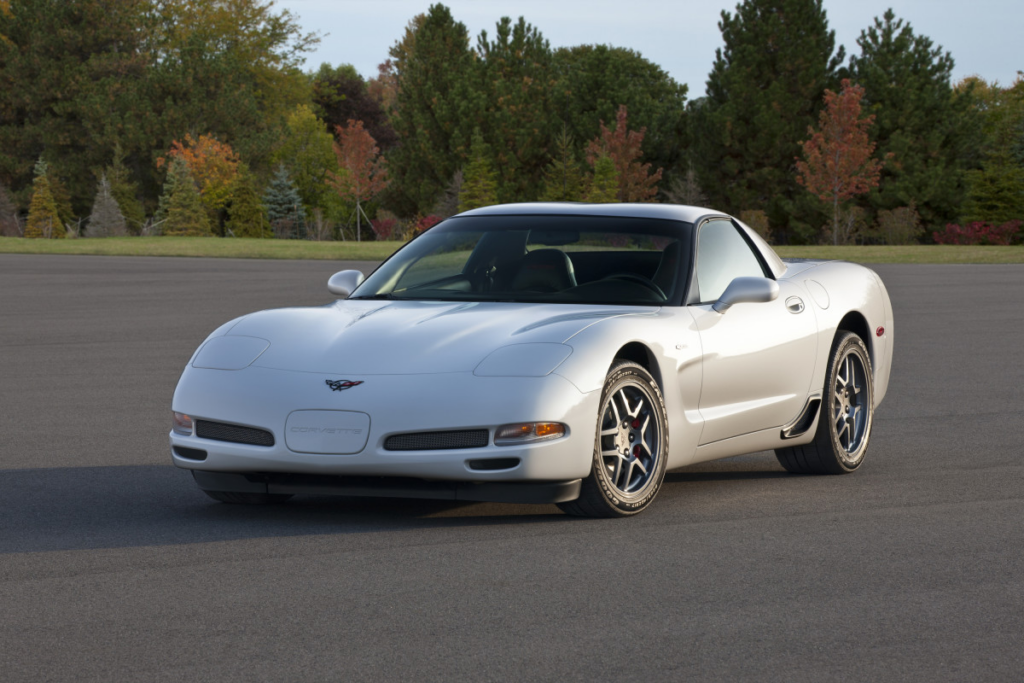
The arrival of the C5 Corvette in 1997 was met with immense anticipation, marking a significant evolution from the C4. This generation was the first to be officially designated by its generation name, C5, and it represented the fastest and most sophisticated Chevrolet Corvette to date. Its styling was an evolutionary refinement of the iconic Corvette profile, featuring lower, rounder lines and more pronounced body curves. Innovations like magnetic-ride adaptive suspension were introduced in 2003.
Underneath, the C5 was revolutionary. It rode on a new platform for improved chassis rigidity, and its transmission (a six-speed manual or four-speed automatic) was relocated to the rear axle for optimized weight distribution. The heart of the C5 was the all-aluminum Gen III LS1 5.7-liter V8, producing 345 horsepower and delivering 0-60 mph in 4.8 seconds, with an impressive 28 mpg highway rating.
Initially offered as a coupe, the C5 expanded to include a convertible in 1998 and a fixed-roof coupe with a welded steel roof in 1999, a precursor to the legendary Z06. The C5 Z06, introduced in 2001, was a significant performance upgrade, featuring a stiffer body and suspension, enhanced brakes, and a more powerful version of the LS6 V8 engine, eventually producing 405 horsepower. By 2004, the Z06 achieved 0-60 mph in just 3.9 seconds.
The C5 era also saw numerous special editions, including Indy 500 pace cars and a 50th-anniversary model. C5 Corvettes offer a compelling blend of performance and value, with good examples typically selling between $17,000 and $26,000, while Z06 and special editions command higher premiums.
Fourth Generation (C4: 1984-1996)
The C4 Corvette represented a significant departure from its predecessors, featuring a completely new design and manufacturing process. Gone was the traditional fiberglass body, replaced by lighter, more durable composite plastics bonded to a steel perimeter frame. The C4 adopted a targa top, which, while reducing chassis rigidity somewhat, contributed to its sleeker profile and improved dynamic limits.
Styled by Jerry Palmer, the C4’s design was futuristic for its time, featuring clean lines and an integrated glass hatchback. The interior was significantly more ergonomic, though the tall door sills required a bit of a climb to enter. Production began in January 1983, with cars arriving at dealerships that spring.
The C4 was powered exclusively by variations of the 5.7-liter small-block V8. Early models featured the L83 engine, while the L98 from 1985 to 1991 offered improved output. A groundbreaking addition was the 1990 ZR1, developed with Lotus, boasting an LT5 V8 that produced 375 horsepower initially. Later C4s, from 1992 to 1996, featured the LT1 engine, with the 1996 Grand Sport receiving the more powerful LT4.
Transmission options included a unique 4+3 Doug Nash manual and a ZF six-speed manual. While the C4 faced some criticism for chassis flex and its plasticky interior, it delivered compelling performance for its era and remains a reliable option, particularly the later models. 1980s C4s are generally the least desirable due to lower power outputs, but offer exceptional value. Most C4s can be found for $8,000 to $16,000, with rare ZR1s and Callaway editions commanding higher prices.
Third Generation (C3: 1968-1982)
The C3 Corvette, the longest-running generation, is instantly recognizable for its curvaceous Mako Shark-inspired styling. Debuting in 1967, it shared its platform with the C2 but featured a dramatically different exterior. Available as a coupe with removable T-tops or a convertible, the C3 offered a range of powerful engines, including the legendary 427 cubic-inch L88 V8.
Early C3s were incredibly potent, with big-block V8s producing upwards of 400 horsepower. However, as emissions regulations and insurance costs escalated, power outputs began to decline throughout the 1970s. The introduction of federal impact bumper regulations in 1973 and 1974 significantly altered the car’s aesthetics. By 1975, big-block engines were discontinued, leaving only the 350 cubic-inch Small Block V8. The convertible body style was also axed in 1975.
Despite diminishing performance, the C3 enjoyed strong sales throughout the late 1970s, largely due to its enduringly attractive styling. The car underwent further styling updates, including a glass hatchback for the final 1982 models. C3 Corvettes span a wide price spectrum, from affordable late-model examples around $10,000 to highly sought-after early models and convertibles that can fetch significantly more. They are generally easy to maintain, making them a rewarding entry into classic car ownership.
Second Generation (C2: 1963-1967)
The C2 Sting Ray, considered by many to be the most aesthetically pleasing Chevrolet Corvette ever produced, debuted in 1963. Its design, inspired by racing prototypes and aquatic life, featured a sleek, low-slung body, hidden headlights, and a distinctive split rear window on the coupe (removed in 1964 for improved visibility).
Underneath, the C2 boasted an all-new chassis engineered by Zora Arkus-Duntov, featuring four-wheel disc brakes and independent rear suspension. This era saw the introduction of more powerful engines, including the small-block 327 V8, available with up to 375 horsepower, and the potent big-block 396 and later the legendary 427 V8, the latter reportedly producing around 500 horsepower in the L88 variant.
The C2 Sting Ray was a formidable performer for its time, capable of 0-60 mph in under 5 seconds. Today, C2 Sting Rays are highly coveted collector cars, with prices ranging from $50,000 for solid, running examples to upwards of $250,000 for pristine, high-performance models, especially the rare 1963 split-window coupes and fuel-injected “Fuelies.”
First Generation (C1: 1953-1962)
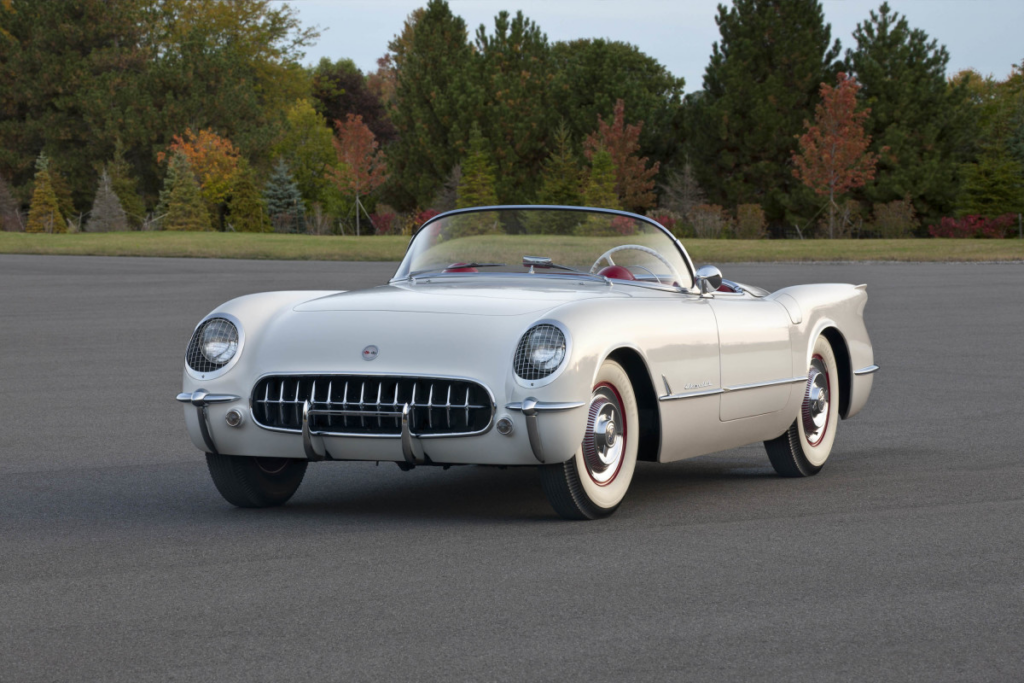
The C1 Corvette was born out of GM’s Motorama in 1953, conceived as America’s answer to the burgeoning popularity of European sports cars. Its groundbreaking fiberglass body allowed for the production of its curvy form. However, early C1s were hampered by a lack of performance, utilizing a Chevrolet inline-six engine paired with a two-speed automatic transmission. Sales were slow, and the car lacked critical features like side windows and a robust convertible top.
The transformation began in 1955 with the introduction of Chevrolet’s new Small Block V8 engine. This powerplant, combined with a three-speed manual transmission, fundamentally changed the Corvette’s character. A significant restyling in 1956 further enhanced its sporty appeal with a new grille, concave sides, and sculpted hood. Horsepower increased steadily through the late 1950s, with the addition of a four-speed manual in 1957 and optional mechanical fuel injection in 1958, which became a hallmark of high-performance Corvettes.
Later C1 models, particularly those from 1958-1962, received further styling refinements, including quad headlights and an updated interior. While early C1s are historically significant, they are less desirable for driving enthusiasts compared to later generations. Today, all C1 Corvettes are valuable collector items, typically ranging from $60,000 to $120,000, with exceptional examples fetching significantly more.
Embark on Your Corvette Journey
The Chevrolet Corvette is more than just a car; it’s an automotive legend, a symbol of American ingenuity and performance. Whether your dream is the raw power of a modern Z06, the classic elegance of a C2 Sting Ray, or the accessible thrill of a well-maintained C5 or C6, the Corvette family offers an experience unlike any other. Thorough research, careful inspection, and understanding the unique attributes of each generation are paramount.
Ready to find the Chevrolet Corvette that will ignite your passion? Explore reputable dealerships, connect with specialized brokers, and engage with Corvette enthusiast forums. Your ultimate American sports car experience awaits.